
The world of artificial intelligence has just experienced a historic week. Just two days after the United States banned the export of Claude Fable 5, China responded with remarkable precision: the launch of GLM 5.2. In less than 24 hours, this open-source model climbed to the top of the global BridgeBench rankings, surpassing several key metrics of the American model whose access had just been restricted. Here’s what you need to know about GLM 5.2, its real capabilities, and what this means for the global AI ecosystem.
What Is GLM 5.2?
GLM 5.2 is the latest large language model developed by the Chinese research team behind the GLM (General Language Model) series. It is part of a line of ambitious open-source models designed to compete head-on with major proprietary American platforms such as OpenAI, Anthropic, and Google DeepMind.
Unlike its predecessors, GLM 5.2 is not just a general-purpose model. It has been designed and optimized to excel in high-value tasks: code generation, complex logical reasoning, debugging, refactoring, and application security. It is precisely on these axes that independent benchmarks have evaluated it—and the results are compelling.
Performance That Shakes Up the Global Rankings
GLM 5.2 Leads on BridgeBench
BridgeBench is currently one of the most serious references for comparing AI models on software development tasks. The platform evaluates models on 30 challenging tasks covering various domains: user interface generation, algorithms, debugging, refactoring, reasoning, and security.
The results published on June 14, 2026, are unequivocal:
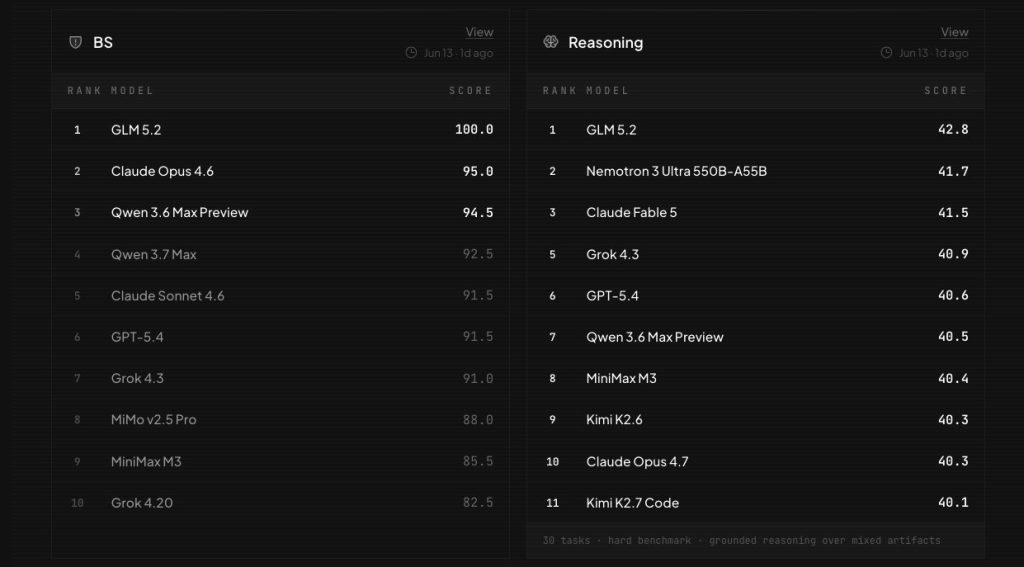
- #1 worldwide in overall score (BS) with a perfect score of 100.0
- #1 in Reasoning with a score of 42.8, directly surpassing Claude Fable 5
- Best open-source Chinese model ever tested by the BridgeBench team
These figures, officially relayed by the @bridgebench account, confirm what several testers had anticipated during early access phases: GLM 5.2 is not a niche model—it is a top-tier competitor.
Remarkable Inference Speed
Beyond the raw quality of responses, the speed of a model is a determining criterion for developers and businesses. GLM 5.2 boasts a generation speed of 300 tokens per second, placing it among the fastest models available at this performance level. For real-time applications or a code assistant integrated into an IDE, this speed makes a concrete difference in the daily lives of technical teams.
A Cost Divided by Ten
This is undoubtedly the most compelling argument for organizations looking to deploy AI at scale. GLM 5.2 is accessible at approximately one-tenth the cost of equivalent competing models. In a context where corporate AI budgets are closely scrutinized, this price difference represents a major competitive advantage—especially when performance is on par.
How to Use GLM 5.2 in Your Development Tools
Compatibility with the Existing AI Development Ecosystem
One of GLM 5.2’s strengths is its compatibility with the existing ecosystem of AI development tools. Thanks to an OpenAI-compatible API, integration is quick and does not require deep reconfiguration of your workflows.
Integration via Cline or Any OpenAI-Compatible Tool
Here are the essential steps to connect GLM 5.2 to a tool like Cline, according to Z.AI’s official documentation:
- Select OpenAI Compatible as the API provider.
- Enter the base URL:
https://api.z.ai/api/coding/paas/v4 - Enter your Z.AI API key.
- Choose Custom Model and enter the model name:
glm-5.2 - Set the context window size to 1,000,000 tokens.
- Adjust the temperature according to the nature of your tasks.
This integration flexibility makes GLM 5.2 a particularly pragmatic choice for teams already equipped with AI tools, without requiring infrastructure changes.
“Vibe Coding” with GLM 5.2
The concept of vibe coding—an approach where you describe in natural language what you want to build and let the model generate the corresponding code—finds particularly fertile ground in GLM 5.2. Early demonstrations available in early access, shared by specialized content creators like AICodeKing, show impressive capabilities for generating interfaces and application logic with just a few prompts.
BridgeBench also integrates this dimension into its evaluation, with dedicated categories for UI generation and execution speed—two areas where GLM 5.2 performs remarkably well.
What GLM 5.2 Reveals About the Global AI Race
The timeline of events speaks volumes: the U.S. ban on Fable 5 one day, the launch of GLM 5.2 the next, and the top global ranking the day after. This scenario illustrates a reality that many industry observers have been pointing out for years: export restrictions are not a viable strategy for slowing innovation in a globalized open-source ecosystem.
When a model is released as open source, its weights, architectures, and learnings circulate. Research teams around the world benefit from them, refine them, and surpass them. GLM 5.2 is the most recent and striking illustration of this: far from being hindered by U.S. regulatory decisions, Chinese AI development continues to advance at a sustained pace, with results that speak for themselves on independent benchmarks.
This is not a matter of geopolitics—it’s a matter of technological dynamics. And GLM 5.2 has just demonstrated that this dynamic does not stop at borders.
Conclusion: GLM 5.2 Redefines Open-Source AI Standards
In just a few hours, GLM 5.2 achieved what few models manage to do: establish itself as the uncontested reference in a demanding benchmark, at a fraction of the cost of its direct competitors, with an inference speed that opens new perspectives for real-time applications.
Whether you are an independent developer, a software architect, or a technical manager in an organization, GLM 5.2 seriously deserves to be evaluated in your AI pipelines. The performance is there, the integration tools are accessible, and the value-for-money ratio is hard to ignore.
Ready to test GLM 5.2 in your own projects? Start by exploring Z.AI’s official documentation, set up your environment with Cline or Claude Code, and measure for yourself the difference this model can make in your daily development work.

Regis Vansnick is a recognized expert with extensive experience at the intersection of technology, business, and innovation. His professional career is marked by a deep understanding of digital transformation and strategic management.


