
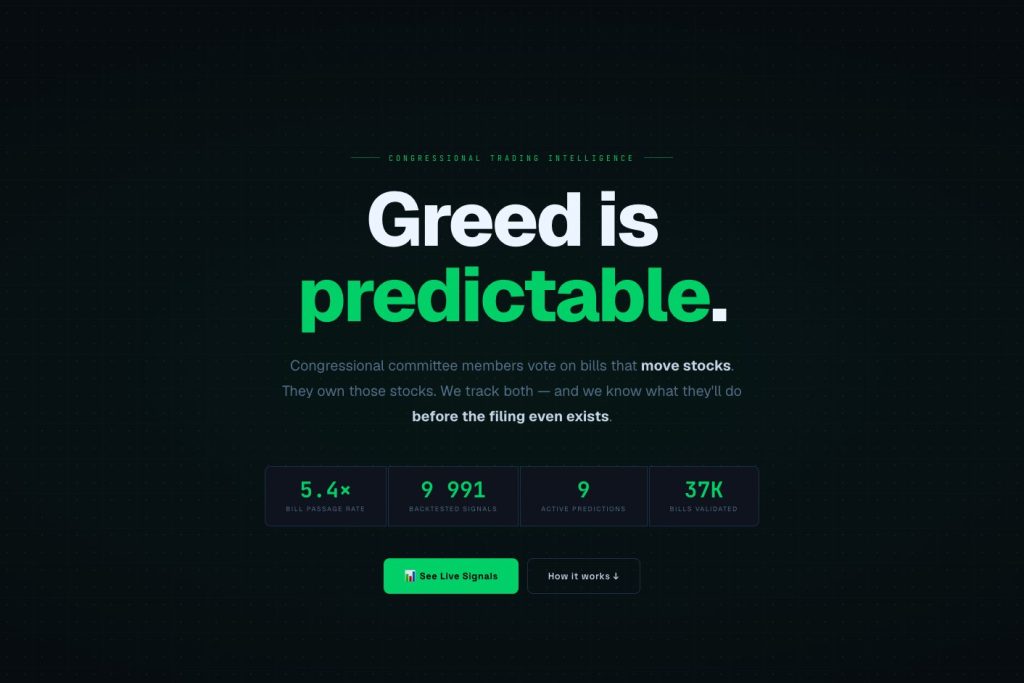
GovGreed is a data intelligence platform that uses machine learning to expose a deeply uncomfortable truth about the U.S. Congress: more than half of all stock purchases made by lawmakers over the past 16 months involved companies directly affected by legislation those same lawmakers later voted on. Built on direct federal data feeds and a seven-layer ML model, GovGreed has scored 190,000 trades across 540 politicians, revealing patterns so clear and consistent that they are impossible to dismiss as coincidence.
What Is GovGreed and Why Does It Matter?
GovGreed is an AI-powered transparency platform designed to cross-reference every stock trade disclosed by a sitting U.S. politician with the bills controlled by their committees, the campaign contributions they receive, and the companies directly impacted by their votes. The platform pulls from approved, direct connections to federal government data systems including STOCK Act disclosures, SEC Form 4 filings, Congress.gov bill text, committee assignments, and FEC campaign finance records.
The platform does not rely on scrapers or third-party middlemen. Its intelligence stack combines three data layers: federal government systems, licensed private market feeds, and proprietary ML enrichment. The result is a signal network that other financial or political transparency tools simply do not offer.
The Scale of the Problem in Numbers
The raw statistics that GovGreed has surfaced are striking. According to data published directly on the platform at govgreed.com, 343 of 540 Congress members (63.8%) actively trade stocks while having access to non-public legislative information. That represents nearly two-thirds of the entire U.S. legislature placing market bets with an informational advantage that would land any hedge fund manager in federal prison.
| Statistic | Figure |
|---|---|
| Total congressional trades scored | 190,000+ |
| Politicians profiled | 540 |
| Trades on stocks later voted on | 56% (approx. 6,170 of 11,016 buys) |
| Late STOCK Act filings | 23,426 (12.5% of all trades) |
| Penalty for late filing | $200 fine |
| Congressional prosecutions under STOCK Act | Zero |
| Active Triple Signals tracked (119th Congress) | 752 |
| Pass rate multiplier for Triple Signal bills | 5.4x the average |
| Bills scored by ML model | 45,000+ |
| Bill Pass Index AUC score | 0.74 |
How GovGreed’s AI Engine Actually Works
Unlike platforms that simply republish raw STOCK Act disclosures, GovGreed passes every congressional trade through a multi-stage intelligence process. The goal is not to show you the data. The goal is to show you what the data means.
The Seven-Layer Scoring Model
Every trade on the platform is scored across seven independent dimensions: politician quality, bill correlation, herd convergence, technical context, sector momentum, campaign contributions, and lobbying alignment. When multiple layers point to the same politician and the same stock simultaneously, a convergence multiplier activates, raising the signal score by up to 2x its base value.
A+ tier signals, the highest confidence category, have achieved a 72.7% win rate in 30-day backtests with an average return of +10.7% versus the S&P 500. That is not a marketing claim. It is a figure derived from backtesting across 37,132 bills from the 117th and 118th Congress, each with a known legislative outcome.
The Triple Signal: Where Trading, Lawmaking, and Donor Money Collide
GovGreed’s most powerful detection mechanism is what it calls the Triple Signal. This signal fires when three conditions align simultaneously for the same politician:
- The politician sits on the committee that controls a specific bill.
- The politician has traded stock in a company directly affected by that bill.
- The politician has received campaign contributions from the same industry.
Currently, 752 active Triple Signals are being tracked in the 119th Congress. The legislative outcome attached to these signals is extraordinary: bills flagged with Triple Signal indicators pass at 5.4 times the average rate. That is not a statistical anomaly. That is a repeatable, documented pattern of insider behavior operating in plain sight.
Herd Signals and Predictive Markup Alerts
Beyond the Triple Signal, GovGreed tracks what it calls “herd signals,” which fire when three or more politicians independently buy the same stock. The platform currently tracks 31 active herds, each interpreted as a potential indicator of shared access to non-public legislative knowledge.
The platform also monitors the seven stages of the legislative pipeline. The markup stage, when a committee formally advances a bill, is identified as the critical moment when insider-informed trading most frequently occurs. GovGreed fires predictive alerts up to seven days before markup events, giving subscribers time to act before any STOCK Act filing even exists.
In a Q1 2026 backtest, nine such predictions were generated with a 100% hit rate. These were real congressional trades predicted before the official disclosure was filed.
The Politicians GovGreed Has Profiled
GovGreed builds detailed behavioral profiles on every tracked politician using a combination of 70 features per individual, LLM-generated analysis, and a proprietary “Greediness” metric. Some of the most notable figures surfaced by the platform include Nancy Pelosi, whose estimated portfolio stands at $194 million with a Greediness score of 98.1 out of 100. Ro Khanna leads in raw trade volume with 48,257 trades across more than 1,300 tickers. Michael McCaul filed 6,670 of his 32,302 trades late, while Thomas Suozzi filed 86.4% of his trades late with an average delay of 396 days, meaning disclosures arrived more than a year after the transactions occurred.
These are not obscure backbenchers. They are committee chairs, party leadership, and senior lawmakers writing the very regulations that govern the markets they are actively trading.
The Bill Pass Index: Predicting Legislation Like a Market
One of GovGreed’s most technically sophisticated features is its Bill Pass Index, a deep-learning model trained on 37,132 bills with known outcomes. The model achieves an AUC of 0.74, meaning its probability estimates are well-calibrated and auditable. When the model assigns a 30% pass likelihood to a bill, approximately 30% of those bills actually pass. The methodology is published and open to review.
This matters enormously for context. A pending bill, for example, might show a 62% pass likelihood per the model. If a committee insider bought $480,000 in affected stock eleven days before a markup on that same bill, the Bill Pass Index transforms that trade from a suspicious coincidence into a measurable, scoreable signal. GovGreed identifies these situations in real time.
Why Congressional Insider Trading Persists
The STOCK Act was passed in 2012 specifically to prohibit members of Congress from trading on non-public legislative information. In practice, its enforcement mechanism is a $200 fine. There have been zero prosecutions in the thirteen years since the law was enacted.
A bipartisan bill to ban congressional stock trading outright was introduced in January 2026. It has the support of more than 80% of American voters. It remains stalled in committee, controlled by the very lawmakers who profit most from the status quo. The people who would need to vote yes are the same people who benefit most from voting no.
GovGreed did not uncover information that Congress was hiding. The data is technically public, spread across STOCK Act databases, SEC filings, FEC records, and Congress.gov. What GovGreed did was organize that public information into patterns so clear and consistent that the behavior they describe can no longer be denied or dismissed.
Who GovGreed Is Built For
The platform serves several distinct audiences. Retail investors use it to track which stocks are attracting insider legislative interest before major market moves. Journalists and researchers use its verified data exports and press portal to build accountability reporting. Policy advocates use it to demonstrate, with precision, the scale of the conflict-of-interest problem in Congress.
GovGreed offers a free tier with ten AI queries per day and access to basic signal tiers. Its Founders plan, currently priced at $24.50 per month, includes full access to the ML scoring stack, 819+ active predictions, committee markup alerts with seven-day lead time, unlimited AI chat powered by Claude Sonnet with full database access, and a $100,000 paper trading portfolio using live Alpaca pricing. All future features are included with no upsells.
Conclusion: Accountability Requires Visibility
GovGreed represents a new category of civic technology, one that transforms publicly available government data into something actionable, legible, and impossible to ignore. The platform does not allege corruption. It scores behavior. And when 56% of congressional stock purchases involve companies whose fate will be decided by the buyer’s own vote, the scores speak for themselves.
If you believe that the people writing America’s laws should not be profiting from insider knowledge of those same laws, the most powerful thing you can do right now is understand the system in detail. Visit GovGreed.com, run a free conflict check on your own representatives, and see for yourself what the data shows. The receipts are already public. GovGreed just makes them readable.

Regis Vansnick is a recognized expert with extensive experience at the intersection of technology, business, and innovation. His professional career is marked by a deep understanding of digital transformation and strategic management.


