
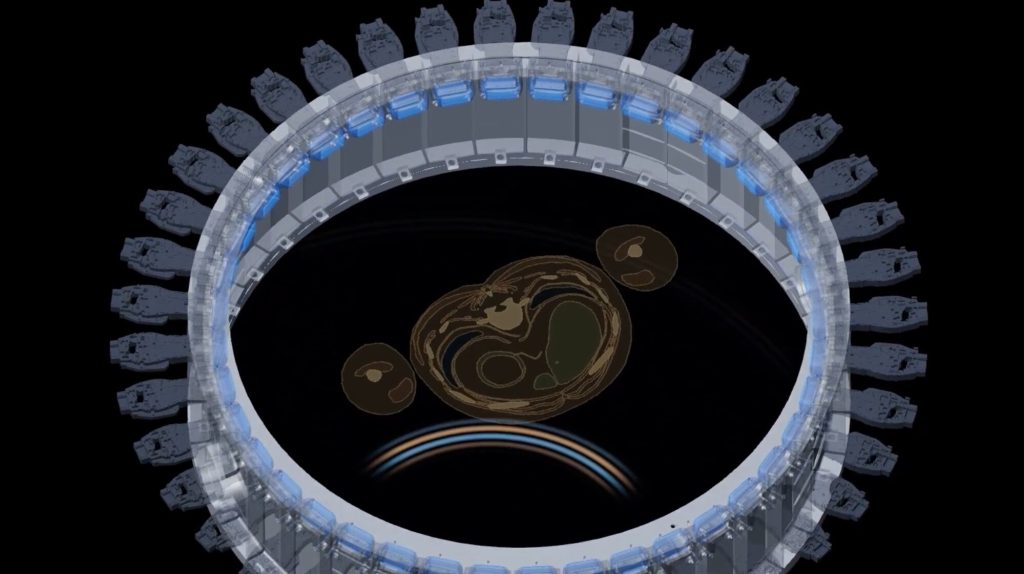
Midjourney, the AI image generation company best known for turning text prompts into striking visuals, has announced a dramatic expansion into medical technology. The company revealed plans on Wednesday to develop a full-body ultrasonic scanner capable of imaging the human body in under 60 seconds, and to house the machines inside a network of wellness spas, starting in San Francisco. The move signals a deliberate strategic reinvention, one that repositions Midjourney as a health data company with long-term ambitions to reshape preventive medicine globally.
A Scanner Born From Image Reconstruction Expertise
At first glance, the leap from AI-generated art to medical hardware appears baffling. However, a closer look at the underlying technology reveals a logical and deliberate progression. The Midjourney Scanner works on the principle of ultrasonic computed tomography: half a million sensors, each roughly the size of a grain of sand, surround the user’s submerged body and simultaneously fire ultrasonic sound waves from every angle. The sensors then record the scattered reverberations that bounce back from muscles, organs, and tissue.
The result is terabytes of raw acoustic data produced every second. That raw input is, in essence, noise. Transforming it into a clean, diagnostically useful three-dimensional image is a notoriously difficult inverse problem, one that has stalled every previous commercial attempt at ultrasonic CT. This is precisely where Midjourney’s core expertise becomes relevant.
Why Midjourney’s AI Background Is the Key Differentiator
The company spent years developing algorithms designed to extract coherent, high-resolution images from ambiguous, incomplete, or noisy inputs. That process, applied to text prompts and latent diffusion models, is structurally identical to the challenge of reconstructing a sharp anatomical image from scattered acoustic waves. Midjourney has effectively redirected its reconstruction engine from visual prompts to sound data. The hardware, supplied through a licensing agreement signed with ultrasound-on-chip manufacturer Butterfly Network in November 2025, was never the bottleneck. The reconstruction layer was, and that is the component Midjourney already had.
Speed, Comfort, and Accessibility as Core Design Principles
The Midjourney Scanner is engineered around a user experience that contrasts sharply with the clinical environment of a conventional MRI. A standard full-body MRI session typically requires between 60 and 90 minutes inside a loud, enclosed magnetic tube, with the patient required to remain completely still. The Midjourney Scanner targets a total scan duration of under 60 seconds, a reduction of approximately 100 times, while producing three-dimensional imagery with resolution down to a fraction of a millimeter, comparable in detail to today’s MRI outputs.
The scanning process begins when a user steps onto a platform and is gradually submerged in water at a rate of approximately two inches per second. The body passes through the ring of sensors as it descends, with the water acting as a medium for optimal ultrasonic wave transmission. The company has described the sensation as being surrounded, from every angle, by the echolocation of half a million tiny dolphins. There is no radiation involved, no magnetic field, and no requirement for the user to remain rigidly still throughout the process.
The Spa Model: Making Medical Scanning a Routine Habit
Perhaps the most unconventional element of Midjourney’s announcement is the distribution strategy. Rather than positioning the Scanner as a hospital device or a clinical diagnostic tool, the company intends to embed it inside high-end wellness spas. The Midjourney Spa will include conventional amenities such as hot tubs and cold plunge pools, with scanning rooms described as cozy spaces filled with golden light where the medical imaging occurs almost incidentally during a relaxing visit.
The company has stated its intention to open its first spa in downtown San Francisco before the end of next year, with the facility operating around the clock. The logic is straightforward: if early detection of disease depends on people choosing to get scanned regularly, the experience of scanning must become something people want to repeat, not something they endure reluctantly once every few years. In Midjourney’s own framing, the scan is a side effect of the spa visit. Users leave with a comprehensive library of data about their internal health without ever thinking of themselves as having attended a medical appointment.
Regulatory Path, Hardware Roadmap, and Global Expansion
Phased Development Over Five Years
Midjourney has outlined a detailed multi-year roadmap for the Scanner program. Over the next 12 months, the team, led by Ahmad Abbas (who joined Midjourney in late 2023 after working on the Apple Vision Pro), will focus on refining reconstruction algorithms, conducting research trials, and designing a second-generation hardware prototype. A submission to the U.S. Food and Drug Administration for diagnostic approval represents the next major regulatory milestone.
By 2028, the company plans to introduce a third-generation machine incorporating custom silicon designed to deliver substantially improved image quality. That generation is described internally as the point at which the Scanner will become capable of competing directly with standard clinical MRIs. The company also intends to expand spa locations to additional cities starting that year.
The 2031 Target: 50,000 Machines and a Billion Monthly Scans
The scale of Midjourney’s stated ambition is significant. The company has set a goal of deploying 50,000 scanners worldwide by 2031. If achieved, and if each machine operates continuously, the network could theoretically produce approximately one billion full-body scans every month. That volume would represent the largest longitudinal dataset of human anatomy ever assembled, a library of imaging data that grows more valuable with every additional scan.
The implications for the company’s AI models are substantial. Each scan feeds back into the reconstruction algorithms, sharpening their accuracy. A sharper model produces better images, which produce richer data, which trains a better model in return. The flywheel dynamic is familiar from consumer AI platforms, but applied here to a dataset that no competitor, whether a hospital network, a pharmaceutical company, or a tech giant, could replicate without Midjourney’s hardware footprint.
A Strategic Vision Disguised as a Hardware Announcement
Midjourney has been explicit that this project represents a new identity for the company, not a sideline. In its blog post, titled “A New Era for Midjourney,” the company acknowledged that the Scanner is unrelated to anything it has previously released, while framing the move as a direct answer to the question of what kind of company it wants to become. Midjourney Medical is its answer, with the Scanner as the first product in what the company clearly envisions as a broader health technology portfolio.
- The company has no outside investors, removing the pressure of quarterly hardware margins and allowing it to treat scan fees as secondary to data accumulation.
- The stated public health ambition is significant: Midjourney has claimed that widespread early imaging could, in its view, prevent up to 30 percent of all deaths and reduce global healthcare costs by as much as 50 percent.
Those projections are bold and unverified, and the Scanner itself remains in early development, with fundamental computational challenges still to be resolved. However, the strategic coherence behind the announcement is harder to dismiss. Midjourney was always an image company. It has now identified a category of image that no one else has the tools, the algorithms, or the infrastructure to generate at scale. The medical pivot, seen in that light, is less of a surprise and more of an extension.
A technical dive inside our new "Midjourney Scanner" pic.twitter.com/wJBHz2O7ro
— Midjourney (@midjourney) June 18, 2026

Regis Vansnick is a recognized expert with extensive experience at the intersection of technology, business, and innovation. His professional career is marked by a deep understanding of digital transformation and strategic management.


