
The technology landscape shifted seismically this week as Apple and Google announced a landmark, multi-year partnership to integrate Gemini artificial intelligence directly into the core of the iOS ecosystem. For years, Siri has operated as a relatively static, rule-based assistant, often lagging behind the conversational fluidity of modern Large Language Models (LLMs). This collaboration signals a definitive end to that era. By selecting Google’s Gemini as the foundational model for the next generation of Apple Intelligence, the Cupertino-based giant is making a calculated trade-off: sacrificing total vertical integration for immediate access to the world’s most advanced reasoning capabilities. This move not only redefines the iPhone experience but also solidifies a dangerous duopoly in the consumer AI market.
The Engine of Execution: Siri as an Autonomous Agent
The narrative surrounding this partnership extends far beyond a simple feature upgrade. It represents a fundamental shift in how we perceive digital assistants. In previous iterations, Siri was a dispatcher, executing simple commands like “set a timer” or “send a text.” With the integration of Gemini, Siri is poised to become an autonomous agent, capable of complex, multi-step reasoning and contextual understanding.
This transition is the “Engine of Execution” that will power the future of mobile computing. Google now effectively owns the “brain” of the world’s most premium hardware. While Apple provides the sleek chassis, the secure enclave, and the user interface, the cognitive processing—the ability to understand nuance, draft complex emails, or analyze images—will be powered by Google’s infrastructure. This creates a symbiotic relationship where Apple gains a competitive AI overnight, and Google secures its models on the devices of over 1.5 billion active users. It is a victory for Google’s reach, but also a tacit admission by Apple that their in-house models, while efficient, lacked the raw power required for the next generation of agentic computing.
From Reactive to Proactive
The shift from a rule-based system to a generative one allows Siri to move from reactive responses to proactive assistance. Instead of merely retrieving weather data, the new Siri could analyze your calendar, the current weather, and traffic patterns to suggest the optimal departure time for a meeting, complete with a drafted excuse text for the host if you are running late. This level of reasoning is exactly what Apple lacked and what Google’s Gemini excels at.
The Hybrid Model: Privacy Meets Power
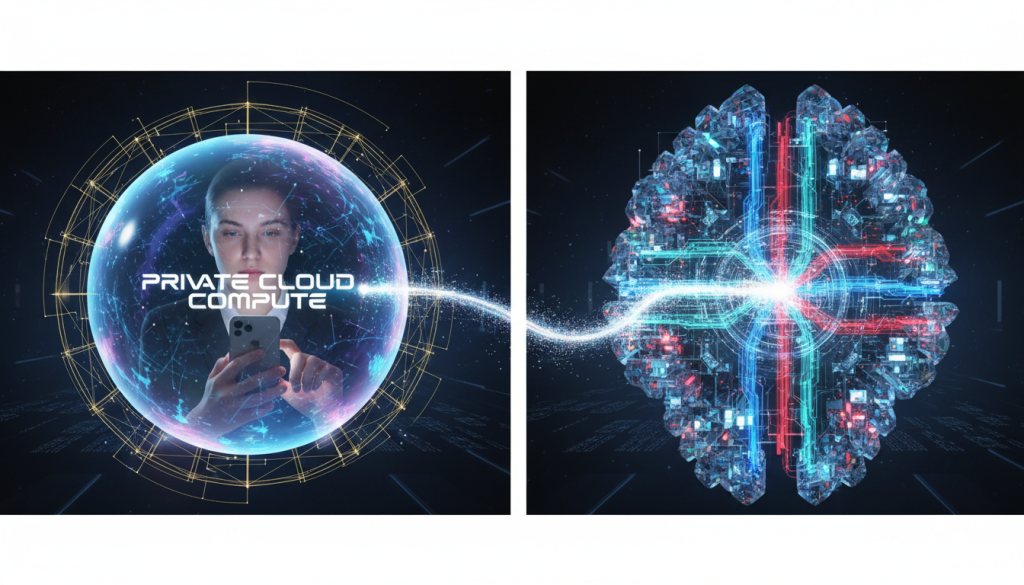
A critical component of this partnership—and the primary defense against antitrust scrutiny—is the technical architecture known as the “Hybrid Model.” Apple has built its reputation on privacy, specifically the concept of “Private Cloud Compute” (PCC). The challenge has always been how to run massive LLMs, which require immense computational power, without sending all user data to a third-party server.
The synergy between Apple’s Private Cloud Compute and Google’s Cloud technology attempts to solve this. When a user asks Siri a complex question that requires heavy LLM processing, the request is encrypted and sent to Google’s cloud infrastructure. However, the processing is done within a secure environment that Apple controls, ensuring that Google does not retain the data or use it for model training. Apple maintains the privacy wrapper; Google provides the raw processing muscle. This addresses the “why” of the partnership: Apple needed the power of a hyperscaler, but refused to compromise on their privacy narrative. By leveraging Google’s custom TPU (Tensor Processing Unit) clusters, Apple can offload the heavy lifting while keeping the user experience within the Apple ecosystem.
The Economic Ripple Effect
This partnership creates a massive economic ripple effect, specifically validating the “Silver Loop” of infrastructure demand. As billions of iPhones begin offloading complex queries to Google’s cloud, the demand for Google’s TPU and GPU clusters will skyrocket. This deal effectively monetizes Google’s massive capital expenditure on hardware by renting it out to Apple. It creates a feedback loop: more usage of Gemini on iPhone necessitates more Google data centers, which in turn allows for the training of even larger, more capable models. It is a massive consolidation of the hardware and software supply chain.
Market Disruption: A Decisive Blow to OpenAI
The choice of Gemini over OpenAI’s GPT-4 or GPT-5 is perhaps the most significant market disruption of the announcement. Throughout 2024, rumors swirled that Apple was in deep talks with OpenAI. By choosing Google, Apple has sent a clear signal to the market. It highlights a potential lack of scalability or a misalignment in privacy philosophy with OpenAI, or simply that Google’s offering was technologically superior and more cost-effective at scale.
For OpenAI, this is a crushing blow. Integration into the iOS ecosystem was viewed as the “holy grail” for ChatGPT’s consumer reach. Being locked out of the default assistant role on the iPhone relegates OpenAI to a third-party app status, competing against a deeply integrated, system-level AI. This move effectively neutralizes OpenAI’s advantage in the mobile space and forces them to rely on Android manufacturers or their own hardware ventures, like the rumored “ChatGPT Phone.”
The Duopoly of Intelligence
The alliance creates what critics are calling a “duopoly of intelligence.” On one side, you have Microsoft with its Copilot ecosystem, deeply integrated into Windows and Office. On the other, you have the Apple-Google axis: Apple controlling the premium hardware interface, and Google controlling the cognitive processing engine. This leaves very little room for other players to compete in the consumer space.
Regulators in the EU and the US are already signaling scrutiny. The concern is that this partnership further entrenches the dominance of Big Tech, making it nearly impossible for smaller AI startups to gain access to the scale of distribution that the iPhone provides. If the default, high-intelligence assistant on the most popular device in the world is powered by Google, the competitive landscape for AI innovation narrows significantly.
Comparative Analysis: The Evolution of Siri
To understand the magnitude of this shift, one must look at the architectural differences between the current assistant and the upcoming Gemini-powered iteration. The transition moves Siri from a deterministic logic tree to a probabilistic neural network.
| Feature Set | Old Siri (Rule-Based) | Gemini-Powered Siri (Agentic) |
|---|---|---|
| Reasoning | Linear; follows strict if/then logic. | Multi-step; understands context and nuance. |
| Language | Limited to pre-defined responses. | Generative; creates unique text and code. |
| Processing | On-device (Neural Engine) only. | Hybrid: On-device + Private Cloud (Google TPU). |
| Use Case | Setting alarms, checking weather, basic search. | Coding, complex analysis, creative writing, agentic tasks. |
The “Why Now?” Factor
The timing of this announcement is not coincidental. Apple is currently facing a critical juncture in its product lifecycle. The initial rollout of “Apple Intelligence” in 2024 was met with mixed reviews; while privacy-focused, the on-device models were noticeably less capable than cloud-based competitors. The “limitations of Apple’s 2024/2025 on-device models” became the elephant in the room—users want privacy, but they also want intelligence.
Apple realized that to keep the iPhone relevant as an AI-first device, they could not rely solely on their own silicon for processing. The gap between what an on-device model can do (roughly 3 billion parameters) versus what a cloud model can do (hundreds of billions of parameters) is simply too vast for complex reasoning. By partnering with Google now, Apple bridges this gap immediately. It allows them to market a “supercharged Siri” for the iPhone 16 and future lineups without waiting years to catch up on server-side infrastructure.
Regulatory and Ethical Implications
The partnership invites intense regulatory scrutiny. The European Commission has already been investigating the dominance of Big Tech in the AI sector. This deal essentially hands the keys to the most valuable user base in the world to the search giant that is already under antitrust watch.
Furthermore, the ethical implications of a single company (Google) providing the AI brain for the vast majority of the world’s smartphones are profound. It raises questions about bias, censorship, and the uniformity of information. If Google’s Gemini has a particular political slant or bias in its training data, that bias is now injected directly into the default assistant of the iPhone. Apple is betting that its strict oversight of the “Private Cloud Compute” environment will mitigate these risks, but the source of the intelligence remains external.

Conclusion: A New Era of Mobile Computing
The Apple-Google Gemini partnership is not merely a software update; it is a restructuring of the mobile ecosystem. It marks the moment where hardware supremacy bowed to algorithmic supremacy. For Apple, it is a necessary move to maintain the iPhone’s status as the premier tool for creativity and productivity. For Google, it is the ultimate validation of its AI investments, securing a monopoly on the intelligence layer of the most popular hardware platform on earth.
As we look toward the release of the updated Siri, the industry watches with bated breath. Will this “duopoly of intelligence” deliver the seamless, agentic future we were promised? Or will it simply consolidate power among the few giants capable of building the massive infrastructure required to power our digital lives? One thing is certain: the Siri of yesterday is gone, and the Google-powered agent of tomorrow is ready to take its place.
SUGGESTED_TITLE: The Intelligence Monopoly: Apple and Google Unite on Gemini
The technology landscape shifted seismically this week as Apple and Google announced a landmark, multi-year partnership to integrate Gemini artificial intelligence directly into the core of the iOS ecosystem. For years, Siri has operated as a relatively static, rule-based assistant, often lagging behind the conversational fluidity of modern Large Language Models (LLMs). This collaboration signals a definitive end to that era. By selecting Google’s Gemini as the foundational model for the next generation of Apple Intelligence, the Cupertino-based giant is making a calculated trade-off: sacrificing total vertical integration for immediate access to the world’s most advanced reasoning capabilities. This move not only redefines the iPhone experience but also solidifies a dangerous duopoly in the consumer AI market.
The Engine of Execution: Siri as an Autonomous Agent
The narrative surrounding this partnership extends far beyond a simple feature upgrade. It represents a fundamental shift in how we perceive digital assistants. In previous iterations, Siri was a dispatcher, executing simple commands like “set a timer” or “send a text.” With the integration of Gemini, Siri is poised to become an autonomous agent, capable of complex, multi-step reasoning and contextual understanding.
This transition is the “Engine of Execution” that will power the future of mobile computing. Google now effectively owns the “brain” of the world’s most premium hardware. While Apple provides the sleek chassis, the secure enclave, and the user interface, the cognitive processing—the ability to understand nuance, draft complex emails, or analyze images—will be powered by Google’s infrastructure. This creates a symbiotic relationship where Apple gains a competitive AI overnight, and Google secures its models on the devices of over 1.5 billion active users. It is a victory for Google’s reach, but also a tacit admission by Apple that their in-house models, while efficient, lacked the raw power required for the next generation of agentic computing.
From Reactive to Proactive
The shift from a rule-based system to a generative one allows Siri to move from reactive responses to proactive assistance. Instead of merely retrieving weather data, the new Siri could analyze your calendar, the current weather, and traffic patterns to suggest the optimal departure time for a meeting, complete with a drafted excuse text for the host if you are running late. This level of reasoning is exactly what Apple lacked and what Google’s Gemini excels at.
The Hybrid Model: Privacy Meets Power
A critical component of this partnership—and the primary defense against antitrust scrutiny—is the technical architecture known as the “Hybrid Model.” Apple has built its reputation on privacy, specifically the concept of “Private Cloud Compute” (PCC). The challenge has always been how to run massive LLMs, which require immense computational power, without sending all user data to a third-party server.
The synergy between Apple’s Private Cloud Compute and Google’s Cloud technology attempts to solve this. When a user asks Siri a complex question that requires heavy LLM processing, the request is encrypted and sent to Google’s cloud infrastructure. However, the processing is done within a secure environment that Apple controls, ensuring that Google does not retain the data or use it for model training. Apple maintains the privacy wrapper; Google provides the raw processing muscle. This addresses the “why” of the partnership: Apple needed the power of a hyperscaler, but refused to compromise on their privacy narrative. By leveraging Google’s custom TPU (Tensor Processing Unit) clusters, Apple can offload the heavy lifting while keeping the user experience within the Apple ecosystem.
The Economic Ripple Effect
This partnership creates a massive economic ripple effect, specifically validating the “Silver Loop” of infrastructure demand. As billions of iPhones begin offloading complex queries to Google’s cloud, the demand for Google’s TPU and GPU clusters will skyrocket. This deal effectively monetizes Google’s massive capital expenditure on hardware by renting it out to Apple. It creates a feedback loop: more usage of Gemini on iPhone necessitates more Google data centers, which in turn allows for the training of even larger, more capable models. It is a massive consolidation of the hardware and software supply chain.
Market Disruption: A Decisive Blow to OpenAI
The choice of Gemini over OpenAI’s GPT-4 or GPT-5 is perhaps the most significant market disruption of the announcement. Throughout 2024, rumors swirled that Apple was in deep talks with OpenAI. By choosing Google, Apple has sent a clear signal to the market. It highlights a potential lack of scalability or a misalignment in privacy philosophy with OpenAI, or simply that Google’s offering was technologically superior and more cost-effective at scale.
For OpenAI, this is a crushing blow. Integration into the iOS ecosystem was viewed as the “holy grail” for ChatGPT’s consumer reach. Being locked out of the default assistant role on the iPhone relegates OpenAI to a third-party app status, competing against a deeply integrated, system-level AI. This move effectively neutralizes OpenAI’s advantage in the mobile space and forces them to rely on Android manufacturers or their own hardware ventures, like the rumored “ChatGPT Phone.”
The Duopoly of Intelligence
The alliance creates what critics are calling a “duopoly of intelligence.” On one side, you have Microsoft with its Copilot ecosystem, deeply integrated into Windows and Office. On the other, you have the Apple-Google axis: Apple controlling the premium hardware interface, and Google controlling the cognitive processing engine. This leaves very little room for other players to compete in the consumer space.
Regulators in the EU and the US are already signaling scrutiny. The concern is that this partnership further entrenches the dominance of Big Tech, making it nearly impossible for smaller AI startups to gain access to the scale of distribution that the iPhone provides. If the default, high-intelligence assistant on the most popular device in the world is powered by Google, the competitive landscape for AI innovation narrows significantly.
Comparative Analysis: The Evolution of Siri
To understand the magnitude of this shift, one must look at the architectural differences between the current assistant and the upcoming Gemini-powered iteration. The transition moves Siri from a deterministic logic tree to a probabilistic neural network.
| Feature Set | Old Siri (Rule-Based) | Gemini-Powered Siri (Agentic) |
|---|---|---|
| Reasoning | Linear; follows strict if/then logic. | Multi-step; understands context and nuance. |
| Language | Limited to pre-defined responses. | Generative; creates unique text and code. |
| Processing | On-device (Neural Engine) only. | Hybrid: On-device + Private Cloud (Google TPU). |
| Use Case | Setting alarms, checking weather, basic search. | Coding, complex analysis, creative writing, agentic tasks. |
The “Why Now?” Factor
The timing of this announcement is not coincidental. Apple is currently facing a critical juncture in its product lifecycle. The initial rollout of “Apple Intelligence” in 2024 was met with mixed reviews; while privacy-focused, the on-device models were noticeably less capable than cloud-based competitors. The “limitations of Apple’s 2024/2025 on-device models” became the elephant in the room—users want privacy, but they also want intelligence.
Apple realized that to keep the iPhone relevant as an AI-first device, they could not rely solely on their own silicon for processing. The gap between what an on-device model can do (roughly 3 billion parameters) versus what a cloud model can do (hundreds of billions of parameters) is simply too vast for complex reasoning. By partnering with Google now, Apple bridges this gap immediately. It allows them to market a “supercharged Siri” for the iPhone 16 and future lineups without waiting years to catch up on server-side infrastructure.
Regulatory and Ethical Implications
The partnership invites intense regulatory scrutiny. The European Commission has already been investigating the dominance of Big Tech in the AI sector. This deal essentially hands the keys to the most valuable user base in the world to the search giant that is already under antitrust watch.
Furthermore, the ethical implications of a single company (Google) providing the AI brain for the vast majority of the world’s smartphones are profound. It raises questions about bias, censorship, and the uniformity of information. If Google’s Gemini has a particular political slant or bias in its training data, that bias is now injected directly into the default assistant of the iPhone. Apple is betting that its strict oversight of the “Private Cloud Compute” environment will mitigate these risks, but the source of the intelligence remains external.
Conclusion: A New Era of Mobile Computing
The Apple-Google Gemini partnership is not merely a software update; it is a restructuring of the mobile ecosystem. It marks the moment where hardware supremacy bowed to algorithmic supremacy. For Apple, it is a necessary move to maintain the iPhone’s status as the premier tool for creativity and productivity. For Google, it is the ultimate validation of its AI investments, securing a monopoly on the intelligence layer of the most popular hardware platform on earth.
As we look toward the release of the updated Siri, the industry watches with bated breath. Will this “duopoly of intelligence” deliver the seamless, agentic future we were promised? Or will it simply consolidate power among the few giants capable of building the massive infrastructure required to power our digital lives? One thing is certain: the Siri of yesterday is gone, and the Google-powered agent of tomorrow is ready to take its place.

Tanguy is a key figure in the team, responsible for in-depth analysis of technological trends and their practical application in modern business. One of his specialities are the blockchains.


