

The Shifting Landscape of Digital Assistants. For over a decade, the consumer technology landscape has been defined by a duopoly of convenience. Apple’s Siri and Google’s Assistant have dominated the mobile experience, relying on rigid APIs and pre-defined integrations to handle simple queries. However, a fundamental shift is occurring in the world of artificial intelligence, moving from passive response systems to active, agentic workflows. Anthropic, the AI safety company, is positioning itself not merely as a competitor, but as a distinct third pillar of intelligence that challenges the closed ecosystems of the Apple-Google axis.
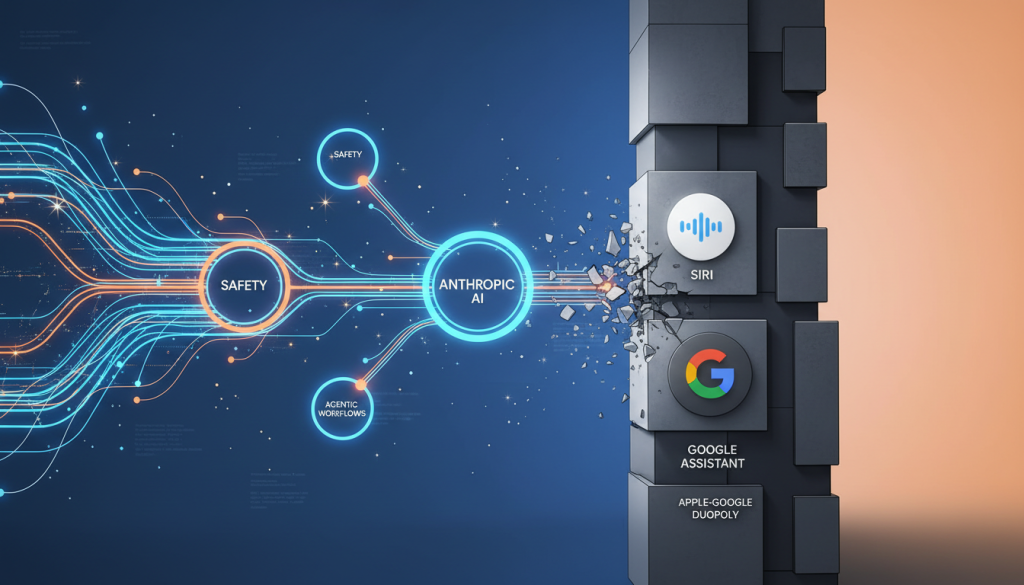
At the heart of this challenge is the concept of “Constitutional AI” – a methodology that embeds a set of principles directly into the model’s decision-making process. While Gemini and Siri are optimized for data harvesting and ecosystem lock-in, Anthropic’s approach prioritizes safety, interpretability, and, crucially, deep reasoning. This distinction is becoming vital for enterprise users who require an AI partner capable of handling sensitive data without the inherent conflicts of interest present in advertising-driven models. As we witness the emergence of features like Cowork, the gap between a “smart assistant” and an “agentic colleague” is rapidly closing.
Anthropic’s Agentic Leap: Beyond Simple Prompts
The evolution of Large Language Models (LLMs) has reached an inflection point. We are moving away from the “chatbot” paradigm- where a user asks a question and receives a single, static answer- toward an “agentic” paradigm. In this new model, the AI does not just answer; it acts. Anthropic is leading this charge with capabilities that allow its models to perceive, reason, and execute complex, multi-step tasks.
The Rise of Cowork and Computer Use
Central to this strategy is the evolution of features such as “Computer Use” and the recently introduced “Cowork” capability. According to documentation from Anthropic, Cowork is a research preview that brings the powerful agentic architecture of Claude Code directly to the desktop environment. Unlike traditional AI interactions that are limited to a chat window, Cowork allows the model to interact with the user’s local file system.
The implications are profound. Instead of manually uploading documents or copy-pasting text, a user can grant Claude access to a specific folder. Once access is granted, Claude can read, analyze, organize, and rewrite files directly. This capability mimics the workflow of a human administrative assistant rather than a software tool. It represents a significant departure from the limitations of Siri or Gemini, which are largely confined to their respective operating systems’ sandboxed environments unless specific APIs are available.
Executing Complex, Long-Running Tasks
One of the primary frustrations with current AI assistants is their inability to maintain context over long durations or perform background tasks. Cowork addresses this by operating in a virtual machine environment. When a user describes an outcome—such as “organize all receipts in this folder and create a quarterly expense report”—Claude does not time out.
The system analyzes the request, creates a plan, breaks the work into subtasks, and executes them in parallel. This “sub-agent coordination” allows for the generation of professional outputs, such as Excel spreadsheets with working formulas or formatted PowerPoint presentations, delivered directly to the file system. This workflow is essential for professionals who view AI not as a novelty, but as a productivity multiplier.
In Cowork, you give Claude access to a folder on your computer. Claude can then read, edit, or create files in that folder.
— Claude (@claudeai) January 12, 2026
Try it to create a spreadsheet from a pile of screenshots, or produce a first draft from scattered notes. pic.twitter.com/GEaMgDksUp
Constitutional AI: The Enterprise Trust Factor
In an era where data privacy is a paramount concern, the architecture of an AI model matters as much as its performance. Anthropic has built its brand on “Constitutional AI,” a training method that guides the model toward helpful, harmless, and honest behavior by adhering to a constitution of principles. This creates a distinct competitive advantage when compared to the “black box” nature of some competitors.
Privacy vs. Data Harvesting
The business models of Apple and Google are fundamentally tied to hardware sales and data ecosystems, respectively. While they have made strides in on-device processing, their AI services are often designed to feed back into a larger data loop for personalization and advertising. Anthropic, backed heavily by Amazon, operates on a different model. Their focus is on providing a secure, reasoning engine for enterprise applications.
For businesses handling proprietary code, financial records, or legal documents, the ability to use an AI that is not designed to mine user data for ad targeting is a significant selling point. The “Independent Intelligence” angle is not just marketing; it is a structural reality of how Anthropic designs its safety and privacy protocols.
Overcoming API Limitations
The “Computer Use” evolution highlights a critical weakness in the Apple-Google duopoly: API limitations. Siri and Google Assistant are powerful when interacting with apps that have explicitly built support for them. However, they struggle significantly with “dark data”—unstructured information residing in file folders, local databases, or complex web interfaces that lack APIs.
Anthropic’s approach allows the model to navigate graphical user interfaces (GUIs) just as a human does. By leveraging the Claude in Chrome extension alongside Cowork, the AI can perform tasks that require navigating web interfaces, clicking buttons, and reading dynamic content. This “visual” capability means the AI is not limited by the APIs a developer chose to implement; it can perform any task a human operator could, provided it has the necessary permissions.
The Strategic Alliance: AWS and the Open Ecosystem
No AI exists in a vacuum; it requires immense computational power. The battle for AI supremacy is as much about infrastructure as it is about algorithms. Here, the strategic alliances of the major players define the battlefield.
The Microsoft-OpenAI and Apple-Google Dynamics
Microsoft’s deep integration of OpenAI into its products (Copilot) has created a closed loop within the Windows and Office ecosystem. Similarly, Apple’s recent partnership with Google to integrate Gemini (or similar technology) into the iPhone reinforces the duopoly. These partnerships are designed to keep users within a walled garden, offering convenience at the cost of flexibility.
Anthropic and the AWS Ecosystem
Anthropic stands as the champion of the open, cloud-based ecosystem, primarily through its strategic partnership with Amazon Web Services (AWS). AWS provides the massive clusters of GPUs required to train and run models like Claude. This alliance positions Anthropic as the preferred AI provider for the vast enterprise market already running on AWS.
Unlike the consumer-focused integration of Apple and Google, the AWS-Anthropic partnership is geared toward scalable, secure, and industrial-grade AI deployment. This infrastructure advantage allows Anthropic to focus on “reasoning-heavy” models that require dense computational clusters, without the burden of managing hardware supply chains or consumer retail channels.
Hardware Implications: Fueling the Silver Loop
The shift from simple chatbots to agentic systems that can run long-duration tasks and navigate local file systems has a hidden, physical cost: compute density. As AI models become more sophisticated, the demand for processing power grows exponentially. This surge in compute requirement directly impacts the demand for the infrastructure metals discussed in previous Zumim analyses, specifically silver and copper.
The Demand for Dense Compute
Agentic AI features like Cowork are significantly more computationally intensive than simple text generation. When Claude navigates a folder, reads multiple files, cross-references data, and generates complex outputs, it is utilizing a massive amount of VRAM and GPU cycles. To support these “reasoning-heavy” models, data centers must deploy ever-denser clusters of servers.
Silver and Copper: The Unsung Heroes
This hardware expansion fuels the “Silver Loop.” Silver is the most conductive metal on the periodic table and is indispensable in the manufacturing of semiconductors, switches, and connectors. As Anthropic, AWS, and other providers race to build the infrastructure capable of supporting agentic AI, the demand for silver in server boards and high-performance computing chips is set to skyrocket. Similarly, copper is required for the power delivery and cooling infrastructure necessary to keep these dense compute clusters operational. The race to build the “Third Pillar” of AI is, therefore, a race to secure the physical materials required to power it.
Risks and Responsibilities in the Agentic Era
With great power comes great responsibility. As AI gains the ability to execute actions on a user’s computer, the security surface area expands dramatically. Anthropic is transparent about the risks associated with these research previews.
Managing Local Access
The Cowork documentation explicitly warns that because the AI can make real changes to files, users must be diligent about the permissions they grant. The system is designed to only act on folders the user explicitly shares, but the potential for unintended consequences remains. This is a significant divergence from the passive nature of Siri; an agentic AI can accidentally delete files if misinstructed.
Prompt Injection and Safety
Another risk highlighted by Anthropic is the potential for “prompt injection” attacks. Since agentic AI often interacts with the web to perform tasks, there is a risk that malicious content on a website could hijack the AI’s instructions and cause it to perform unauthorized actions. Anthropic notes that they have built defenses against this, but it remains a complex challenge. For enterprise users, this underscores the importance of Constitutional AI: a model that is trained to refuse unsafe instructions is a necessary safeguard in an agentic world.
Conclusion: The Dawn of the Agentic Workforce
The introduction of capabilities like Cowork and the “Computer Use” evolution signals a pivotal moment in the history of artificial intelligence. Anthropic is successfully carving out a distinct identity as the “Third Pillar,” offering an alternative to the closed, consumer-centric models of Apple and Google. By combining Constitutional AI for safety, agentic workflows for productivity, and a strategic alliance with AWS for infrastructure, Anthropic is building an AI that works for the user, not just the ecosystem.
As these models become more capable, they will inevitably drive a massive build-out of hardware infrastructure, fueling the demand for critical materials like silver and copper. For the discerning professional and the forward-thinking enterprise, the choice is becoming clear: the future of work belongs to those who can leverage independent, reasoning intelligence. Anthropic is not just offering a new chatbot; it is offering a new way to work, one that promises to reshape the digital landscape and the physical economy that supports it.

Loïc Vansnick is the leader of the Zumim project, whose expertise is based on a rare combination of two fundamental areas: he is a certified civil engineer and management engineer


