

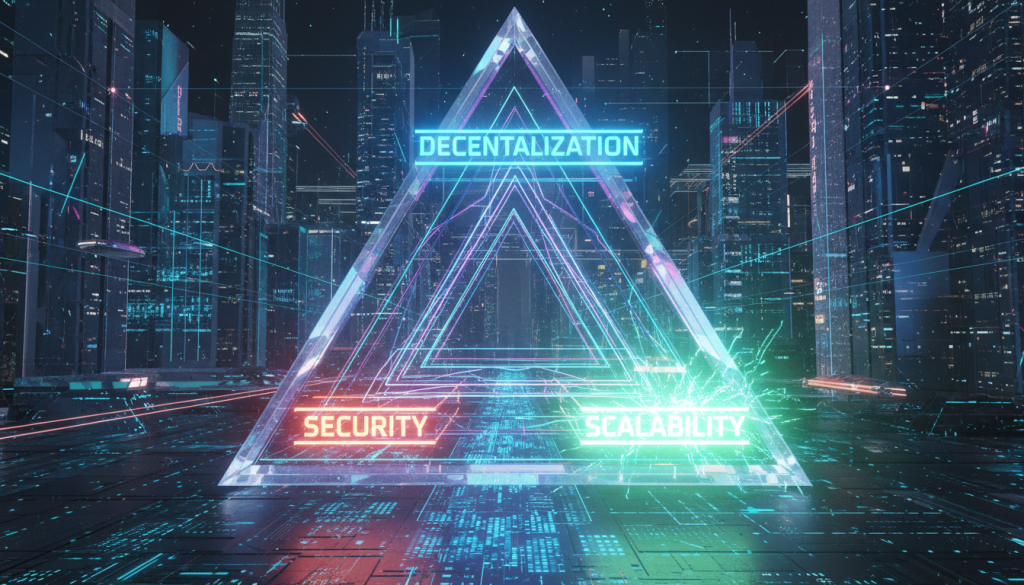
For years, the blockchain industry has been locked in a fierce debate, a constant struggle between three competing ideals: decentralization, security, and scalability. This conflict, known as the “blockchain trilemma,” forced developers to make painful compromises. If you wanted a network that was highly decentralized and secure, it was inevitably slow and expensive. If you wanted speed and low costs, you usually sacrificed the core tenets of censorship resistance. But now, a fundamental shift has occurred. Vitalik Buterin, the co-founder of Ethereum, has declared that this decade-old problem is no longer theoretical : it is solved.
This is not a promise of future technology or a roadmap for the years ahead. The solutions are live, running on the mainnet today. The architecture of Ethereum has evolved from a single, congested highway into a sophisticated, multi-layered ecosystem capable of handling global finance. For entrepreneurs, institutional investors, and technology leaders, this marks a pivotal moment. The conversation is no longer about whether blockchain can scale, but about how quickly the world will migrate to this new, hyper-efficient settlement layer.
Deconstructing the Trilemma: The triangle of compromise
To understand the magnitude of this breakthrough, one must first grasp the constraints of the trilemma. It is often compared to the “iron triangle” of project management: you can have it fast, cheap, or high-quality, but rarely all three simultaneously. In the blockchain world, the vertices are defined as follows:
- Decentralization: The network is not controlled by a single entity. Thousands of nodes independently verify transactions, ensuring censorship resistance and eliminating single points of failure.
- Security: The network is resilient against attacks. It requires an exorbitant amount of energy or capital to compromise the ledger’s integrity (often measured by the cost of a “51% attack”).
- Scalability: The network can process a high volume of transactions quickly and at a low cost, comparable to traditional payment processors.
Historically, increasing the size of blocks to improve scalability meant that fewer people could afford the hardware to run a node, leading to centralization. Ethereum’s previous iterations struggled with this, leading to gas fees that could reach hundreds of dollars during peak demand, rendering it unusable for everyday commerce. The “old” Ethereum prioritized security and decentralization, leaving scalability as the glaring weak point.
The architectural pivot: Rollups and the modular era
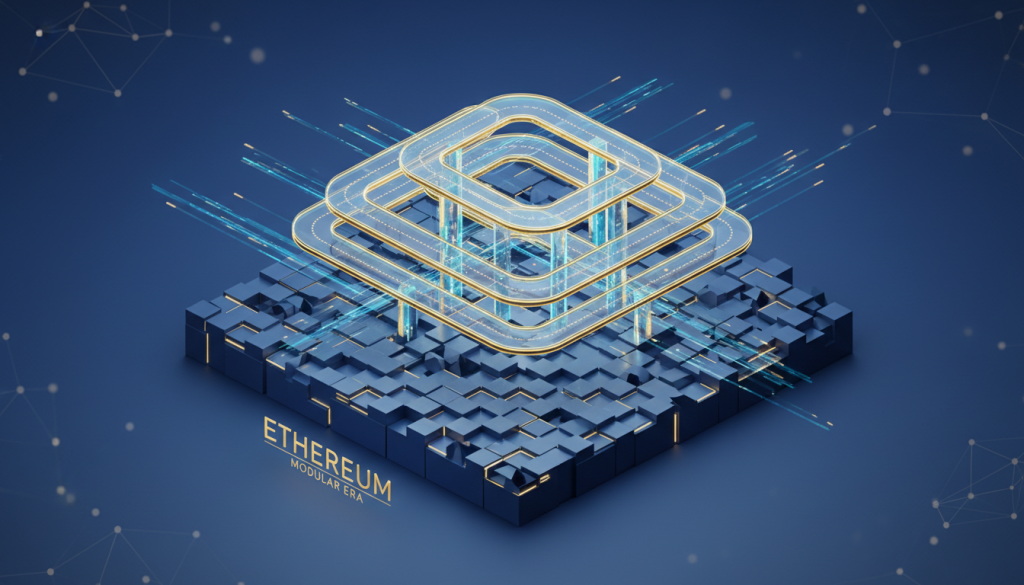
Vitalik Buterin’s solution was not to try to do everything on a single chain. Instead, Ethereum embraced a modular architecture. The core insight is that the base layer (Layer 1) does not need to process every single transaction. It only needs to act as a secure, decentralized foundation—a “truth layer.”
The heavy lifting of execution is offloaded to Layer 2 solutions, specifically Rollups. Think of the Ethereum mainnet as the bedrock foundation of a skyscraper. It is incredibly strong and secure, but it doesn’t need to be fast. The Rollups are the high-speed elevators and express trains running on top of it. They bundle thousands of transactions together off-chain, compress the data, and post a single proof back to the mainnet. This approach drastically reduces fees and increases throughput without compromising the security of the base layer.
This is a stark contrast to competitors like Solana, which attempts to scale by making the base layer itself incredibly fast, often at the cost of higher hardware requirements for validators and occasional network outages. Ethereum’s strategy is to scale by abundance—creating a “city” of interconnected Rollups rather than a single, massive “super-block.”
The two pillars of the solution: ZK-EVMs and PeerDAS
While the concept of Rollups has existed for a few years, two specific technological advancements have cemented the solution of the trilemma: Zero-Knowledge Ethereum Virtual Machines (ZK-EVMs) and Peer Data Availability Sampling (PeerDAS).
Zero-Knowledge Ethereum Virtual Machines (ZK-EVMs)
ZK-EVMs are the “production-quality” breakthrough Buterin highlighted. They utilize cryptographic proofs known as “validity proofs” (ZK-SNARKs or ZK-STARKs). Unlike traditional systems where a node must re-execute every transaction to verify it, a ZK-Rollup can prove mathematically that a batch of transactions was executed correctly without revealing the underlying data. This allows for instant verification on the mainnet.
Buterin notes that while the cryptographic safety mechanisms are still undergoing rigorous auditing, the performance of ZK-EVMs has reached “production-quality.” This means they are fast enough and reliable enough to handle the verification load of the entire network. By 2030, Buterin predicts that ZK-EVMs will become the standard way to validate blocks, effectively making the network infinitely scalable.
Peer Data Availability Sampling (PeerDAS)
If ZK-EVMs are the engine, PeerDAS is the fuel line. One of the biggest bottlenecks for Rollups is “data availability”—ensuring that the data behind the transactions is accessible so that anyone can verify the state of the chain. Previously, nodes had to download massive amounts of data, creating a bottleneck.
PeerDAS, introduced in the recent Fusaka upgrade, changes this. It allows validators to verify that data is available by sampling only small chunks of it, similar to how BitTorrent works. They don’t need to download the entire block to be sure it exists. This drastically reduces the hardware burden on node operators, keeping the network decentralized while supporting massive data throughput for Layer 2 solutions.
Comparative analysis: Ethereum before vs. after
The shift in Ethereum’s capabilities creates a sharp divide between its past perception and its current reality. The “Asymmetry of Information” is high: the general public and many traditional investors still view Ethereum as the “expensive, slow” chain of 2021. However, the on-chain metrics and technical architecture of today present a completely different picture.
The following table illustrates the structural transformation in network capabilities:
| Metric | Ethereum (Pre-Solution Era) | Ethereum (Post-PeerDAS & ZK-EVM) |
|---|---|---|
| Throughput (TPS) | ~15-30 TPS (Layer 1 only) | 100,000+ TPS (via Layer 2 aggregation) |
| Transaction Cost | $5 – $200+ (Variable, often high) | $0.01 – $0.10 (Consistently low) |
| Node Requirements | High storage and bandwidth needed | Reduced via PeerDAS (Light Clients) |
| Security Model | Direct Layer 1 Security | Cryptographic Validity Proofs (ZK) |
Real-World Impact: The global settlement layer
Why does this matter to a business owner or a logistics manager? Because high fees and slow speeds were the only things stopping blockchain from replacing traditional backend infrastructure. With the trilemma solved, Ethereum is transitioning from a “world computer” to a “global settlement layer.”
Consider the tokenization of Real-World Assets (RWA). Previously, putting a \$500,000 property on the blockchain made sense, but trading fractional shares of it would have been impossible due to fees. Now, with near-zero fees, high-frequency trading of tokenized real estate, carbon credits, or supply chain invoices becomes economically viable.
For the entrepreneur, this means access to global liquidity without the friction of intermediaries. For the developer, it means building applications that feel as fast as Web2 applications. The infrastructure is no longer the limiting factor; the only constraint is now imagination.
The competitive landscape: Why modularity wins
Many competitors have touted their speed, but Ethereum’s approach offers a distinct competitive advantage: sovereignty and interoperability. In a modular ecosystem, different Rollups can specialize. One can be optimized for privacy, another for gaming, and another for decentralized finance (DeFi), all settling securely on the same base layer.
This creates a unified liquidity environment. Unlike siloed chains where assets are trapped, Ethereum’s ecosystem allows assets to move freely between Layer 2s via bridges secured by the mainnet. The “Rollup-centric roadmap” ensures that as demand grows, the ecosystem simply adds more “lanes” (Rollups) without congesting the main foundation. This is infinitely more scalable than trying to widen a single highway indefinitely.
Conclusion: The next financial paradigm
Vitalik Buterin’s declaration that the blockchain trilemma is solved is not merely a technical victory; it is the starting gun for the mass adoption of decentralized finance. The technology has matured from a speculative experiment into a robust, scalable, and secure financial infrastructure capable of supporting the global economy.
The asymmetry of information regarding Ethereum’s capabilities presents a massive opportunity. While the public debates the price of ETH, the underlying machinery has been rebuilt to handle the volume of the entire legacy banking system at a fraction of the cost. As we look toward a future where ZK-EVMs validate the blocks and PeerDAS ensures decentralization, one question remains for the traditional financial sector: When the rails are faster, cheaper, and more secure than your own, how do you compete?

Tanguy is a key figure in the team, responsible for in-depth analysis of technological trends and their practical application in modern business. One of his specialities are the blockchains.


