
How can a Harvard-educated physician lose his life savings to a fraudulent hedge fund, or a retired engineer be duped by a simple email promising impossible returns? Intelligence does not provide immunity against deception. In fact, research suggests that sophisticated individuals are often more susceptible to complex scams because they overestimate their ability to spot a fraud. The blueprint for these modern deceptions was drawn nearly a century ago by Charles Ponzi, whose name became synonymous with the very structure of financial fraud. To understand why smart people fall for stupid scams, we must dissect the anatomy of the Ponzi scheme and the psychological triggers that continue to trap intelligent investors today.
The anatomy of a Ponzi Scheme
Charles Ponzi did not invent the scheme that bears his name, but he perfected the marketing of it in 1920. The mechanics are deceptively simple, relying on the oldest rule in finance: money must come from somewhere. A Ponzi scheme is a fraudulent investing scam which generates returns for earlier investors with money taken from later investors. It creates the illusion of a sustainable business model, but it is mathematically destined to collapse when recruitment slows or the operator cannot maintain the promised returns.
The original deception: International reply coupons
Ponzi’s original pitch involved International Reply Coupons (IRCs). He claimed he could buy these coupons in Europe, where currency was devalued post-WWI, and redeem them in the United States for a profit. While the arbitrage theory was technically possible, the profit margins were minuscule and logistical hurdles made mass execution impossible. However, the concept sounded sophisticated enough to impress the average investor. It utilized a veneer of complex financial engineering to hide the fact that the operation was actually paying dividends with new deposits.
The inevitable collapse
The lifespan of a Ponzi scheme is dictated by the rate of new money inflow. As long as the scheme can attract new victims, it can pay off early investors. However, the moment the flow of new capital dries up, the scheme implodes. Ponzi’s empire collapsed in less than a year because the Boston Post began investigating his books, revealing that he was redeeming coupons he didn’t actually possess in sufficient quantities. The collapse wiped out thousands of investors, many of whom were prominent citizens who had ignored red flags because the returns were too good to ignore.

Psychological vulnerabilities: The confluence effect
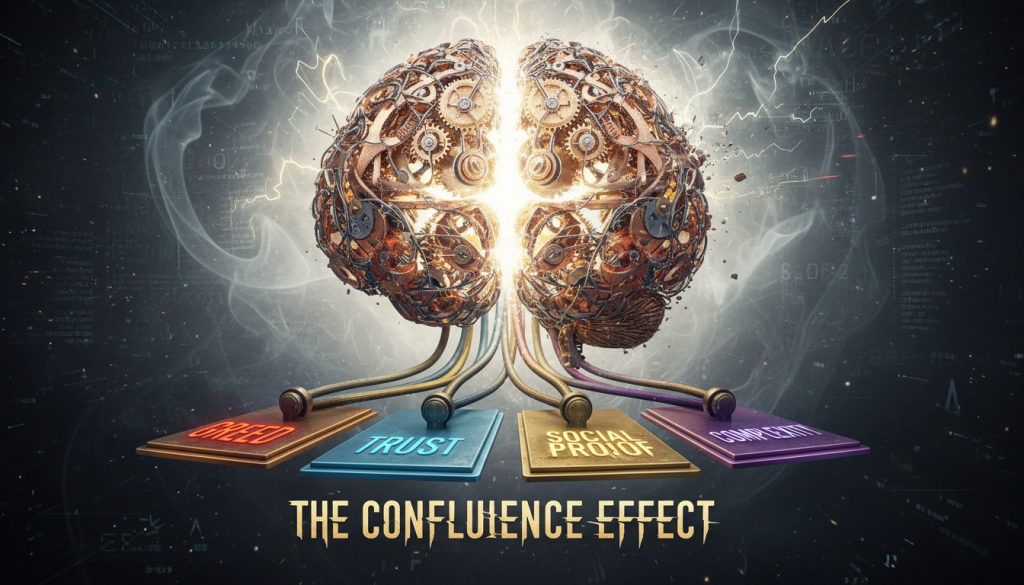
Why do smart people fall for stupid scams? The answer lies in what psychologists call the “confluence effect.” Scams do not succeed solely because of the greed of the victim; they succeed because they align multiple psychological triggers simultaneously. Intelligence often involves deep specialization, and a brilliant brain surgeon may have zero training in forensic accounting. When a scammer speaks with authority on a subject the victim does not understand, the victim’s intelligence can paradoxically work against them, leading them to trust the expert rather than question the premise.
Authority bias and social proof
Humans are hardwired to defer to authority figures and follow the crowd. Ponzi was a charismatic leader who dressed impeccably and projected confidence. When his first investors received their promised returns, they did not keep the money quiet; they told their friends. This created social proof. In the digital age, this is replicated through bot-driven likes, fabricated testimonials, and “exclusive” investment groups on social media. When a smart person sees others—perhaps people they respect—endorsing a scheme, their critical thinking is bypassed by the need for social belonging.
Complexity as a cloak
Scammers often exploit the fear of missing out (FOMO) by wrapping their schemes in complexity. They use jargon like “high-frequency trading algorithms,” “crypto-yield farming,” or “proprietary arbitrage loops.” Intelligent people often feel that if they cannot understand the mechanics, it must be because the mechanism is advanced, not because it is non-existent. They assume that the inability to grasp the details is a failure on their part, rather than a red flag signaling fraud.
Confirmation bias and cognitive dissonance
Once an intelligent person has invested capital and publicly endorsed a venture, it becomes psychologically painful to admit they were wrong. This is cognitive dissonance. If they see a negative news report, they are more likely to dismiss it as a misunderstanding or a hit piece by competitors (confirmation bias) rather than a warning sign. They actively seek information that confirms the safety of their investment and ignore information that threatens it.
Modern iterations: The Ponzi evolution
The Charles Ponzi empire has evolved, but the DNA remains identical. Modern scammers have simply updated the interface while keeping the backend logic the same. They leverage technology to scale their reach and anonymity, making it harder for regulators to intervene before the damage is done.
Cryptocurrency and “Smart” contracts
Crypto-ponzis are currently the most prevalent form of this fraud. Scammers launch a token, promise astronomical yields (APY), and use complex smart contract code to obfuscate the fact that yields are being paid from new deposits. They often use terms like “decentralized finance” (DeFi) to imply that there is no central operator to blame when the system fails. However, if the yield is not generated by actual productive activity (like lending or transaction fees) and is instead just printed via token inflation, it is a Ponzi scheme.
Affinity fraud
Affinity fraud targets specific groups, such as religious communities, elderly groups, or professional associations. Scammers infiltrate these groups, building trust over time. A modern example might be a “Christian investment club” or a “Veterans’ mutual aid fund” that promises steady returns. Because the victims trust the community leader, they bypass due diligence. This was a tactic used by Bernie Madoff, who relied on his reputation within the Jewish community to attract victims who never checked his credentials.
Subscription and Matrix schemes
These are often disguised as legitimate multi-level marketing (MLM) businesses. Participants pay an entry fee and are promised commissions for recruiting others. While legitimate MLMs sell actual products, illegal pyramid schemes focus primarily on recruitment. Intelligent people often fall for these because they believe they are leveraging their business acumen to build a “downline,” failing to realize the mathematical impossibility of infinite recruitment.
Red flags: How to spot the trap
To avoid falling victim to these schemes, one must adopt a healthy skepticism, regardless of intelligence. The following indicators are highly correlated with fraudulent investment opportunities. If an investment opportunity exhibits one or more of these traits, the probability of it being a scam is high.
- Guaranteed High Returns: All investments carry risk. Any promise of high returns with “zero risk” or “guaranteed” profits is the single biggest red flag in finance.
- Unregistered Investments: Legitimate investment opportunities are typically registered with regulatory bodies like the SEC. Scammers often operate in the shadows to avoid oversight.
- Overly Consistent Returns: Markets fluctuate. An investment that generates positive returns every single month, regardless of market conditions, is likely manipulating its numbers.
- Secretive or Complex Strategies: If you cannot explain the investment to a friend in simple terms, you should not invest in it. Scammers rely on confusion.
- Pressure to Act Immediately: Scammers create artificial scarcity (“This deal closes tomorrow!”) to prevent you from doing research or consulting with financial advisors.
- Difficulty Receiving Payments: If you encounter hurdles when trying to withdraw your money, or are encouraged to “reinvest” rather than cash out, the scheme is likely reaching its end stage.
The role of due diligence
Due diligence is not just about reading a prospectus; it is about verifying the claims. Does the auditor exist? Is the auditor reputable? Can the revenue stream be verified independently? In the case of Charles Ponzi, a simple check of his actual coupon holdings would have revealed the fraud. In the case of modern crypto scams, checking the “lock” of liquidity pools or the audit of the smart contract code are the modern equivalents.
Comparative analysis: Historical vs. Modern scams
The following table illustrates how the core mechanisms of Ponzi’s 1920 scheme compare to a modern high-yield crypto scam. The technology changes, but the psychological hooks remain identical.
| Feature | Charles Ponzi (1920) | Modern Crypto Ponzi | Common Psychological Hook |
|---|---|---|---|
| The “Product” | International Reply Coupons (IRCs) | “Yield Farming” or “Arbitrage Bots” | Authority: Uses technical jargon to sound legitimate. |
| The Promise | 50% profit in 45 days | 1% daily returns (3650% APY) | Greed: Returns that defy market realities. |
| The Validation | Early investors paid with new deposits; newspaper hype. | Fake “TVL” (Total Value Locked) and bot transactions. | Social Proof: Seeing others “profit” validates the risk. |
| The Exit | Bank run; regulator seizure. | “Rug pull” (developer drains liquidity). | Trust: Victims leave funds in hoping for higher gains. |
Protecting yourself and others
Protection against scams is a discipline, not a talent. It requires the suspension of ego. The most effective defense is the “pause.” When presented with an opportunity, especially one that seems exclusive or urgent, a mandatory waiting period of 48 to 72 hours can dissolve the emotional pressure. During this time, the investment should be subjected to scrutiny by a neutral third party.
Verify, then trust
Never rely solely on the information provided by the seller. If a fund manager claims audited returns, call the auditing firm directly using a phone number found independently, not one provided by the manager. If a crypto project claims a partnership with a major tech company, verify the announcement on the tech company’s official press page. In the case of Charles Ponzi, the Boston Post did the legwork that the investors should have done; in the modern era, the individual must be their own journalist.
Education as a shield
Understanding basic financial principles is the best inoculation against fraud. Knowing that “risk and reward are correlated” provides a baseline for reality. If an opportunity offers high reward with no risk, it violates the fundamental laws of economics. By educating ourselves on how legitimate investments generate returns (e.g., stock dividends, real estate rental income, bond interest), we can easily spot the imposter that offers returns without a revenue source.

Conclusion
Charles Ponzi’s empire was built on a simple lie that evolved into a complex deception, but it was sustained by human nature. Smart people fall for scams not because they lack intelligence, but because they are human. They are susceptible to greed, authority, and the fear of missing out. The lessons from Ponzi’s empire are not just historical footnotes; they are the operating manual for modern fraudsters. By recognizing the red flags, slowing down the decision-making process, and prioritizing skepticism over excitement, we can protect our hard-earned assets. The best defense against a stupid scam is a smart habit: always ask, “Where does the money actually come from?” If the answer is “the next investor,” walk away.

Regis Vansnick is a recognized expert with extensive experience at the intersection of technology, business, and innovation. His professional career is marked by a deep understanding of digital transformation and strategic management.


