

Anthropic Releases Claude Fable 5, a Restricted Version of Its Previously Withheld Mythos Model
Anthropic, the AI safety company based in San Francisco, officially launched Claude Fable 5 on July 10, 2025, marking the public release of a model built on the same underlying architecture as Claude Mythos — a system the company had previously declined to make generally available due to its advanced offensive cybersecurity capabilities. The release represents a calculated compromise between frontier performance and public safety, arriving at a time of intensifying competition among leading AI developers.
The Same Core Model, With Built-In Guardrails
Claude Fable 5 and its restricted counterpart, Claude Mythos 5, share identical underlying architecture. The key distinction lies not in raw capability but in what each version is permitted to do.
Fable 5 operates with a layer of real-time safety classifiers that monitor incoming requests. When a query touches on offensive cybersecurity, biological research, chemical synthesis, or model distillation, the system automatically redirects the request to Claude Opus 4.8, a less capable but safer model. According to Anthropic, this filtering mechanism activates in fewer than 5% of sessions, meaning the vast majority of users will interact with the full power of the Fable 5 model without interruption.
Claude Mythos 5, by contrast, operates without these restrictions. Access remains tightly controlled and is currently limited to vetted organizations participating in Project Glasswing, Anthropic’s cybersecurity defense initiative. Partners in this program include major technology and security firms such as AWS, Microsoft, Apple, and CrowdStrike. Mythos 5 is described by Anthropic as carrying the strongest cybersecurity capabilities of any AI model currently available.
Benchmark Performance Sets a New Bar
The performance gap between Claude Fable 5 and its competitors is significant across multiple evaluation categories.
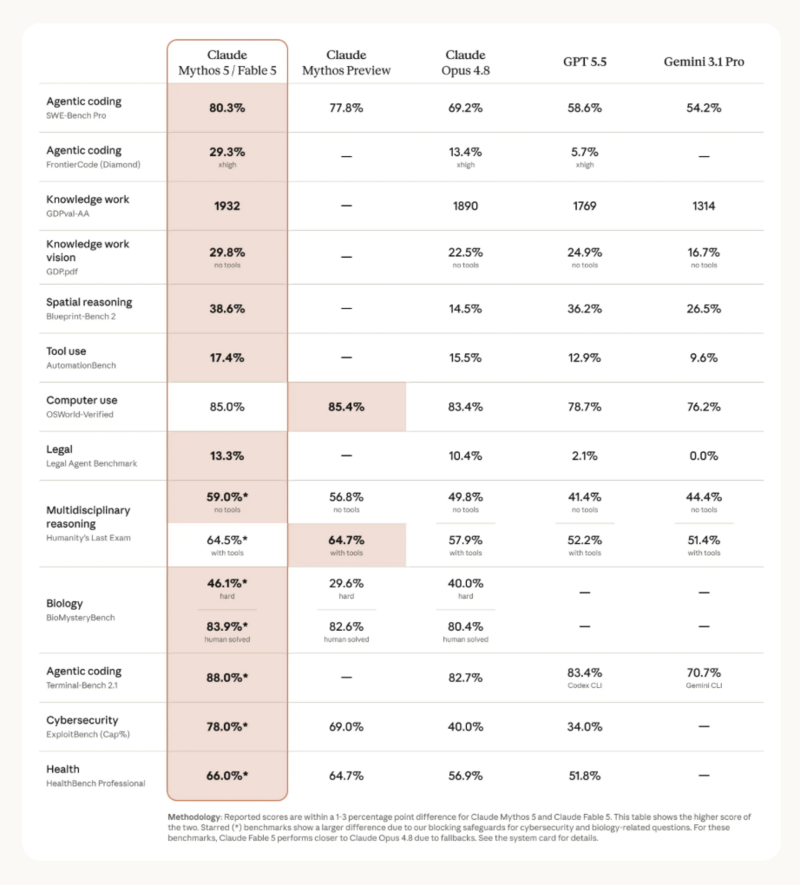
On SWE-Bench Pro, the industry-standard benchmark for software engineering proficiency, Fable 5 achieves a score of 80.3%, compared to 69.2% for Anthropic’s previous flagship model Opus 4.8, 58.6% for OpenAI’s GPT-5.5, and 54.2% for Google’s Gemini 3.1 Pro, according to data published by Anthropic. The performance advantage becomes even more pronounced on harder evaluations: on FrontierCode Diamond, which targets the most demanding production-grade programming tasks, Fable 5 scores 29.3% while Opus 4.8 reaches only 13.4%.
Anthropic also notes that Fable 5’s lead over competing models grows as task complexity increases, suggesting it is particularly well-suited for extended, multi-step workloads that push against the limits of conventional AI systems.
Introducing Claude Fable 5: a Mythos-class model that we’ve made safe for general use.
— Claude (@claudeai) June 9, 2026
Its capabilities exceed those of any model we’ve ever made generally available. pic.twitter.com/2AvmEjHIX8
Real-World Applications Already Demonstrating Impact
Early testing by external partners has produced striking results. Stripe, the payments infrastructure company, reported that Fable 5 compressed months of engineering work into days. In a codebase spanning 50 million lines of Ruby, the model completed a full codebase-wide migration in a single day — a task that Stripe estimated would have required an entire engineering team working manually for more than two months.
Beyond software engineering, Anthropic highlights promising early use cases in life sciences. The company reports that Fable 5 is capable of formulating novel hypotheses and accelerating the development of new therapeutic compounds, though no specific clinical outcomes have been announced at this stage.
In a more unusual demonstration of its vision capabilities, Claude Fable 5 successfully completed the original Pokémon FireRed video game relying solely on screenshots — without maps, navigation aids, or external guidance tools. Previous Claude models required complex assistance systems to reach the same outcome.
A Deliberate Safety Strategy Under Industry Scrutiny
The decision to release a model of this caliber to the public reflects a strategy Anthropic describes as releasing capabilities “as quickly and as safely as possible.” The company acknowledges that the safety filters have been deliberately tuned conservatively for the initial launch, and that they will occasionally block harmless requests as a result. Anthropic has stated its intention to reduce these false positives as additional safeguards are developed in the coming months.
The launch comes roughly two months after Anthropic first unveiled the Mythos architecture — and chose not to release it publicly, citing unacceptable risk. That original decision drew widespread attention in the AI community, as it represented a rare instance of a major lab voluntarily withholding a completed model on safety grounds. Fable 5’s release now revisits that decision with a technical solution: a safeguard layer rather than an outright restriction.
Pricing and Availability
Claude Fable 5 is immediately available through the Claude API, Claude Code, and enterprise cloud platforms including AWS, Google Cloud, and Microsoft Foundry. Subscribers to Anthropic’s Pro, Max, and Team plans also gain access as part of their existing subscriptions.
Anthropic has priced both Fable 5 and Mythos 5 at $10 per million input tokens and $50 per million output tokens — less than half the cost of Claude Mythos Preview, the previous generation model. The company frames the pricing as part of a broader effort to democratize access to frontier AI capabilities without compromising on safety standards.
As AI development cycles continue to compress, the launch of Claude Fable 5 reinforces Anthropic’s position at the forefront of both capability and safety research — while raising new questions about where the line between responsible deployment and competitive pressure ultimately falls.

Regis Vansnick is a recognized expert with extensive experience at the intersection of technology, business, and innovation. His professional career is marked by a deep understanding of digital transformation and strategic management.


