
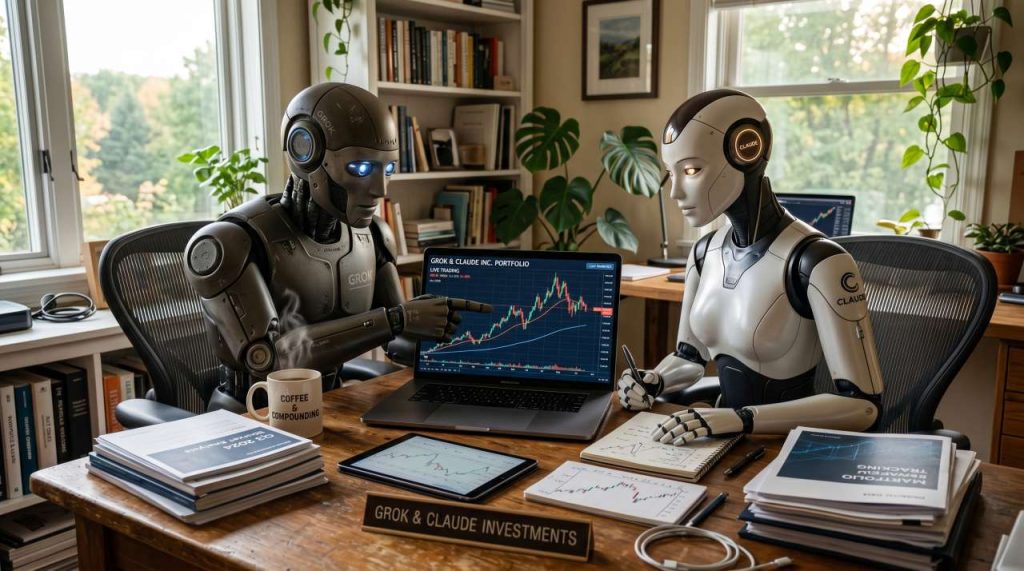
AI-Managed Investment Portfolios Outpace S&P 500 Returns Since Early 2025
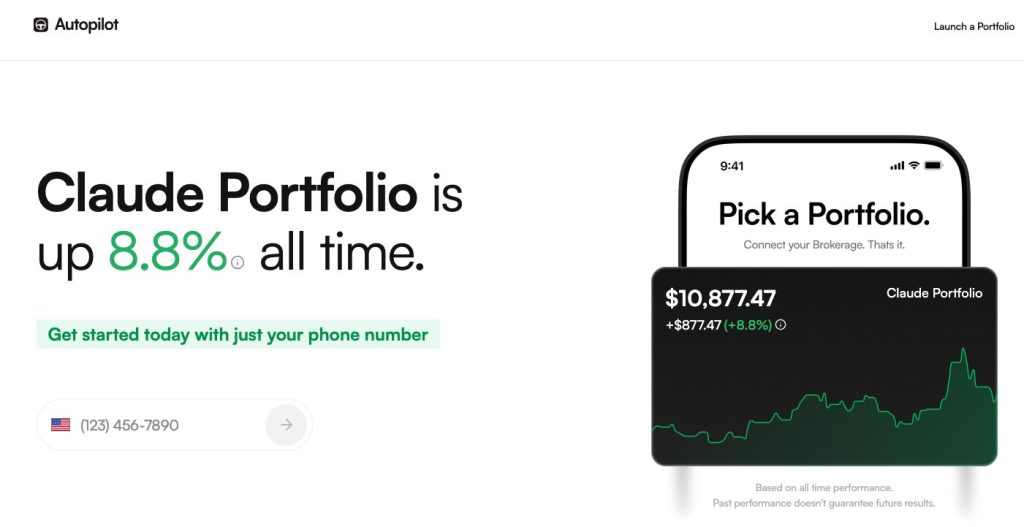
Two artificial intelligence systems : Grok, developed by xAI, and Claude, created by Anthropic have been managing real investment portfolios on the Autopilot platform since February 12, 2025, delivering returns that surpassed the S&P 500’s 40% gain in the last 12 months. The experiment, run by independent researchers under the banner of AI Finance Labs, has attracted over $150 million in mirrored investments from retail users in the United States, raising serious questions about the future role of human fund managers and traditional stock-picking.
How the AI Portfolios Actually Work
The mechanics behind these portfolios are straightforward in concept, though complex in execution. Each month, the AI models analyze a range of inputs macroeconomic conditions, corporate financial data, sector trends, and market sentiment before assigning scores to individual assets. The 15 highest-ranked assets are then selected to form the portfolio for the following month.
The Autopilot platform enables retail investors to mirror these strategies directly from their existing brokerage accounts. Users choose a portfolio, allocate capital, and the platform automatically executes trades on their behalf. The process removes human emotion from the equation — a factor long cited as a primary drag on individual investor performance.
The exact prompts used to instruct the AI models remain undisclosed, but white papers published by the project’s operators AI Finance Labs, led by Alejandro Lira provide a detailed overview of the analytical framework applied to both portfolios.
Current Portfolio Holdings: A Heavy Tilt Toward Technology
As of mid-February 2026, the Grok-managed portfolio held positions in a range of technology and energy companies. Its top allocations included Vertiv (13%), Micron (9%), Broadcom (8%), NRG Energy (7%), AMD (7%), and Meta (7%), alongside positions in Alphabet, Eli Lilly, Microsoft, and sector ETFs covering semiconductors, energy, and gold.
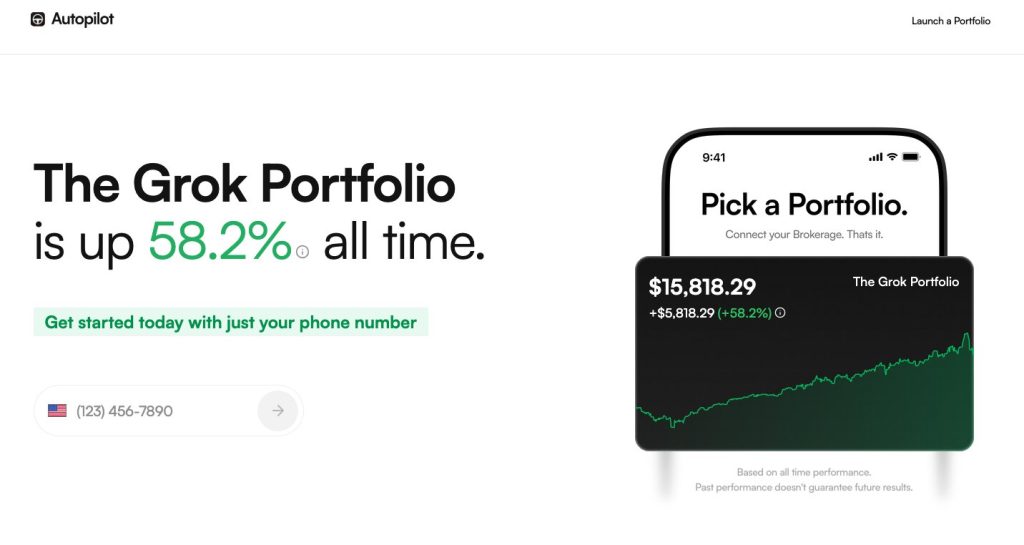
The Claude portfolio, tracked under the handle @theaiportfolios on X, follows a broadly similar logic. Meanwhile, the ChatGPT portfolio a third AI-driven strategy also available on Autopilot is currently invested in Nvidia (10%), an inflation-linked bond ETF (10%), a gold ETF (9%), and Vertiv (9%), among others. It also holds a Bitcoin spot ETF, reflecting a broader appetite for alternative assets.
The overlap between portfolios is notable: Vertiv, NRG Energy, Eli Lilly, Micron, and semiconductor ETFs appear across multiple AI-driven strategies, suggesting a degree of convergence in how different large language models interpret current market conditions.
Impressive Returns | But Is It Skill or Luck?
The central debate surrounding these portfolios is not whether they have performed well but whether their outperformance reflects genuine analytical ability or simply a technology bias that happened to align with one of the most AI-driven bull markets in recent memory.
According to MarketScreener, the S&P 500 returned approximately 12% between February 12, 2025, and February 17, 2026. Both the Grok and ChatGPT portfolios exceeded this benchmark over the same window, a result that has generated significant attention in retail investing communities.
Critics, however, point out that any portfolio heavily weighted toward technology and AI-adjacent stocks would likely have outperformed during this specific period. The “AI revolution” narrative dominated market sentiment throughout 2025, lifting valuations across semiconductors, cloud infrastructure, and data center operators. In that context, it is difficult to isolate whether the models demonstrated foresight or simply rode a powerful macro wave.
Why Grok May Have an Edge Over Rivals
Among the AI models tested, Grok appears to have attracted the most attention from analysts and independent researchers. Several experiments cited by MarketScreener suggest that Grok outperforms competing large language models in both stock selection and short-term trading decisions.
One frequently cited advantage is Grok’s real-time integration with X (formerly Twitter). Because the model is continuously connected to social media activity, it can monitor market sentiment, identify influential voices, track shifts in narrative momentum, and detect unusual spikes in message volume — all signals that traditional quantitative models struggle to capture in real time.
The Pareto Investor, a financial publication on Substack, has also highlighted Grok’s apparent strength in solving problems within uncertain, real-world environments a quality that may translate well to financial markets, which are defined by incomplete information and rapid change.
As of early 2026, the Grok portfolio on Autopilot had attracted over $17 million in mirrored investments, according to data shared via the @grkportfolio account on X, which is operated independently and carries no affiliation with xAI or Grok’s development team.
Significant Capital Already Following AI Signals
The scale of adoption is striking. Across all portfolios available on the Autopilot marketplace, total assets under mirror range from the tens of millions to over half a billion dollars for the most-followed strategies. The leading portfolio on the platform — unrelated to AI — has attracted $512.7 million in mirrored capital, according to figures published on Autopilot’s marketplace page.
The three AI-driven portfolios :Grok, Claude, and ChatGPT collectively account for over $150 million in mirrored investments, a figure that has grown steadily since the project launched in early 2025, per data shared by @theaiportfolios on X.
What Investors Should Consider Before Following an AI Portfolio
Despite the eye-catching performance figures, financial professionals urge caution. Several key risks deserve attention:
- Single-regime performance: These portfolios have only been tested during a sustained technology bull market. How they respond to a sector rotation, a recession, or a sharp correction in AI valuations remains unknown.
- Concentration risk: Both portfolios carry heavy exposure to a narrow set of sectors — primarily technology and energy — which amplifies volatility in adverse conditions.
- Prompt opacity: The exact instructions given to the AI models are not publicly available, making independent verification of the investment process difficult.
- No regulatory oversight: AI-driven portfolios of this kind operate in a gray area of financial regulation. Neither Grok, Claude, nor the platform operators are registered investment advisers in the traditional sense.
A New Chapter in the Active vs. Passive Debate
The rise of AI-managed portfolios adds a new dimension to one of finance’s longest-running arguments. For decades, the evidence has consistently favored passive index investing over active stock-picking. AI now introduces a third category: automated, data-driven selection that operates at a speed and scale no human manager can match.
Whether Grok, Claude, or ChatGPT can sustain their outperformance across multiple market cycles — and across regimes that may not favor technology — will be the defining question for this emerging category of investment strategy. For now, the experiment continues, with hundreds of millions of dollars in real capital riding on the answer.

Regis Vansnick is a recognized expert with extensive experience at the intersection of technology, business, and innovation. His professional career is marked by a deep understanding of digital transformation and strategic management.


