
The era of the human influencer, built on authenticity and physical presence, is facing a profound challenge. A new wave of synthetic personalities, driven by cutting-edge motion control technology, is flooding our social feeds with flawless, cost-effective, and endlessly versatile content. At the forefront of this shift is Kling AI, a platform whose latest iteration, version 2.6, has moved beyond simple text-to-video generation. It now employs a sophisticated “puppeteer” mechanic, using real human movement to animate digital avatars with startling realism. This technological leap doesn’t just create videos; it crafts entire personas, raising urgent questions about the future of marketing, entertainment, and what we perceive as real in the digital age.
The Puppeteer: How Kling 2.6 Masters Digital Motion
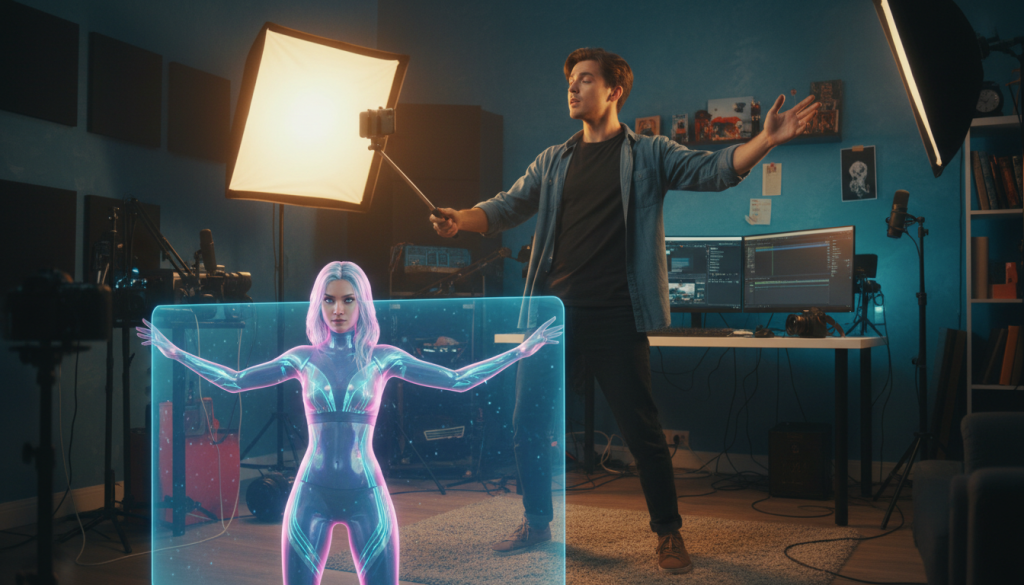
The core innovation of Kling AI’s latest version lies in its departure from purely generative prompts. Instead of relying solely on text descriptions to imagine motion, Kling 2.6 utilizes a reference video—a process that can be best described as advanced digital puppetry. This method provides a foundational layer of authenticity that purely generative systems often struggle to achieve.
From Text to Motion: The Reference Video Advantage
Traditional AI video models attempt to synthesize motion from scratch based on textual commands, such as “a person walking down a street.” While impressive, the results can be inconsistent, with unnatural gait, erratic movements, or a lack of physical weight. Kling’s approach is fundamentally different. By feeding a reference video—often of a real human performing an action—the system analyzes the nuanced movements: the sway of hips, the rotation of shoulders, the subtle shifts in balance. It then transfers this motion data onto a chosen digital character, whether a photorealistic human, an anime-style avatar, or a fantastical creature. This process ensures that the resulting animation adheres to the laws of physics and biomechanics, creating a sense of grounded reality that is critical for audience engagement. The AI doesn’t just guess what a convincing run looks like; it learns from a proven example.
The Mechanics of Control: A New Level of Creative Direction
This puppeteer mechanic grants creators an unprecedented level of control. A filmmaker can film themselves performing a scene in their living room and then apply that exact performance to a digital character in a virtual environment. A brand can capture the subtle gestures of a model and use them to animate a virtual spokesperson for a product demonstration. This technology effectively decouples the performance from the performer’s physical appearance, location, and even identity. The reference video acts as a motion blueprint, which the AI then paints with new visual textures. This allows for the creation of complex, dynamic sequences that would be prohibitively expensive or impossible to film in real life, all while maintaining a core of human-like movement. The result is a hybrid creation: part human performance, part AI-generated visual, blurring the lines between captured reality and synthetic artistry.
The Economic Disruption: Cost, Scale, and the New Influencer Economy
The rise of synthetic influencers is not merely a technological novelty; it represents a seismic economic shift. The traditional influencer marketing industry, valued in the billions, is built on the high costs associated with human talent. Kling AI and similar platforms are dismantling this cost structure, making high-quality video production accessible at a fraction of the price.
Breaking Down the Human Influencer Cost Model
Engaging a human influencer for a campaign involves a complex and expensive web of logistics. The costs extend far beyond the influencer’s fee. They include:
- Talent Fees Rates can range from hundreds to hundreds of thousands of dollars per post, depending on the influencer’s reach and niche.
- Production Costs: This encompasses professional photography/videography, studio rental, equipment, and crew.
- Logistics and Travel: For shoots in specific locations, costs for flights, accommodation, and per diems add up significantly.
- Styling and Makeup: Hair, makeup, and wardrobe are essential for maintaining a brand’s aesthetic and the influencer’s image.
- Scheduling and Coordination: The time spent negotiating contracts, aligning calendars, and managing revisions represents a non-monetary but substantial cost.
- Unpredictability: Human influencers have personal lives, can get sick, or may face public relations issues, introducing risk into campaigns.
The Kling AI Cost Equation: A Paradigm Shift
In stark contrast, the cost structure for generating content with a tool like Kling AI is radically simplified and diminished. While there are costs associated with computing power (discussed later), the direct cost to a brand or creator is minimal. Industry analyses suggest that generating high-quality video segments with Kling can cost as little as $1 for 10 seconds of footage. This price point democratizes content creation. A small business can now produce a month’s worth of polished video ads for the price of a single human influencer post. The economic model shifts from high fixed costs (human talent) to low variable costs (compute time). This enables:
- Unlimited Scale: Generate hundreds of video variants for A/B testing without additional cost.
- 24/7 Content Creation: Synthetic influencers never sleep, get tired, or demand time off, allowing for a constant stream of content.
- Global and Instant Localization: The same synthetic influencer can be made to speak different languages or adapt to cultural nuances with a simple script change, without re-shooting.
- Brand Safety: A synthetic influencer’s “behavior” is entirely controlled by the brand, eliminating the risk of personal scandals or off-script controversies.
This economic pressure will inevitably force a re-evaluation of pricing in the human influencer market, potentially pushing it toward higher-value, more authentic engagements while the bulk of routine promotional content migrates to synthetic alternatives.
Closing the Gap: How Kling AI is Conquering the Uncanny Valley
For years, the “uncanny valley”—the unsettling feeling when a synthetic entity looks almost, but not quite, human—has been a significant barrier to the acceptance of digital humans. Early CGI and deepfake technologies often faltered in rendering the subtle complexities of human expression, particularly in the hands and face. Kling AI’s advancements are systematically closing this gap, creating synthetic beings that are increasingly difficult to distinguish from reality at a casual glance.
The Challenge of Hands and Facial Micro-Expressions
The human brain is exquisitely attuned to the nuances of facial expressions and hand movements. These are the primary channels of non-verbal communication. Previous AI video models often produced distorted hands with too many or too few fingers, or rendered facial expressions that were stiff, robotic, or emotionally inconsistent. Kling 2.6’s motion control, informed by real reference videos, provides a robust solution. By learning from actual human movement, the AI understands the intricate coordination required for a natural smile, a thoughtful glance, or the precise dexterity of hand gestures. The system can now generate fingers that bend realistically, hold objects with appropriate pressure, and convey meaning through gesture. This attention to micro-details is crucial for building trust and relatability.
Performance on Social Media Platforms
The true test of this technology is its performance in the wild—on fast-scrolling social media feeds like TikTok, Instagram Reels, and YouTube Shorts. In this environment, users consume content rapidly, and their scrutiny is limited. A synthetic video that is 95% convincing is often indistinguishable from reality in a 15-second clip. Kling-generated content is now reaching a level of fidelity where the casual scroller is unlikely to pause and analyze the video for flaws. The combination of fluid motion (from the puppeteer mechanic) and high-resolution, coherent visuals means that synthetic influencers can now participate in trends, dance challenges, and storytelling formats with a believability that was unthinkable just a year ago. This “good enough” realism, delivered at scale and low cost, is the key to mass adoption. The uncanny valley is no longer a chasm but a shallow dip that is being rapidly filled by technological progress.
The Zumim Angle: The Invisible Infrastructure of Silicon and Energy
While the spectacle of synthetic influencers captures public imagination, their existence is underpinned by a less glamorous but critically important reality: massive computational infrastructure. The “Fake Influencer” era is, in truth, a “Silicon and Energy” era. The ability to generate high-fidelity, minute-long videos in real-time is not a software miracle alone; it is a feat of hardware engineering and energy consumption.
The Computational Appetite of Video Generation
Generating video is exponentially more complex than generating static images. It requires the AI to understand and maintain consistency across frames—tracking objects, lighting, and physics over time. Kling’s advanced motion control adds another layer of complexity, as it must synthesize high-resolution visuals that align perfectly with the input motion data. This process demands astronomical GPU (Graphics Processing Unit) power. Training a state-of-the-art video generation model like Kling requires thousands of high-end GPUs running for weeks or months, consuming vast amounts of electricity. Even inference—the process of generating a single video from a prompt—is computationally intensive. A few seconds of 1080p video can require the processing power that once took a supercomputer to render a single frame of a Hollywood film.
The Data Center as the New Studio
This computational demand means that the “studio” for the synthetic influencer is no longer a physical location with lights and cameras, but a data center filled with servers. Companies like the creators of Kling AI (and their infrastructure partners) are building and operating these massive computing clusters. The cost of these GPUs, their installation, cooling, and the electricity to power them represents the true capital expenditure behind the synthetic media boom. The $1 per 10 seconds cost to the end-user is a subsidized fraction of the actual compute cost, absorbed by the platform as they scale. This creates a high barrier to entry, consolidating power in the hands of a few tech giants who can afford this infrastructure. The future of synthetic media is therefore not just about software algorithms, but about access to silicon and sustainable energy sources to power the data centers that make it all possible.

Conclusion: Navigating the Synthetic Future
The technological convergence of motion control, AI generation, and scalable infrastructure is irrevocably altering the digital landscape. Kling AI’s puppeteer mechanic is more than a novel tool; it is a catalyst for a new economic and creative paradigm. By dramatically lowering costs, eliminating traditional production barriers, and rapidly closing the realism gap, synthetic influencers present a compelling alternative to their human counterparts for a wide range of applications. However, this future is not without its complexities. The shift raises important ethical considerations regarding transparency, the value of human labor, and the nature of authenticity in a digitally saturated world. As we move forward, the most successful strategies will likely involve a hybrid approach, leveraging the scale and efficiency of synthetic media for broad reach while reserving human connection for deeper, more meaningful engagements. The end of human presence is not imminent, but its role is undeniably being redefined by the silent, powerful machinery of silicon and code.

Regis Vansnick is a recognized expert with extensive experience at the intersection of technology, business, and innovation. His professional career is marked by a deep understanding of digital transformation and strategic management.


