

The Digital Battlefield : In 2026, the concept of a “network war” has moved from speculative fiction to a tangible geopolitical reality. This conflict is fought on two distinct fronts. The first is a physical front, characterized by state-imposed internet shutdowns and network blocks, as seen in regions like Nepal and Iran, where governments attempt to sever the digital lifeline of their citizens. The second is a legislative and technological front, exemplified by the European Union’s proposed “Chat Control” measures, which seek to mandate mass surveillance of private communications by breaking encryption. In this environment, a new class of technology is emerging not merely as a tool for convenience, but as a critical instrument of digital resistance and privacy preservation. These are decentralized messaging platforms, which leverage peer-to-peer (P2P) architectures to create networks that are inherently resistant to both physical censorship and centralized intrusion.
Outmaneuvering the Physical Shutdown
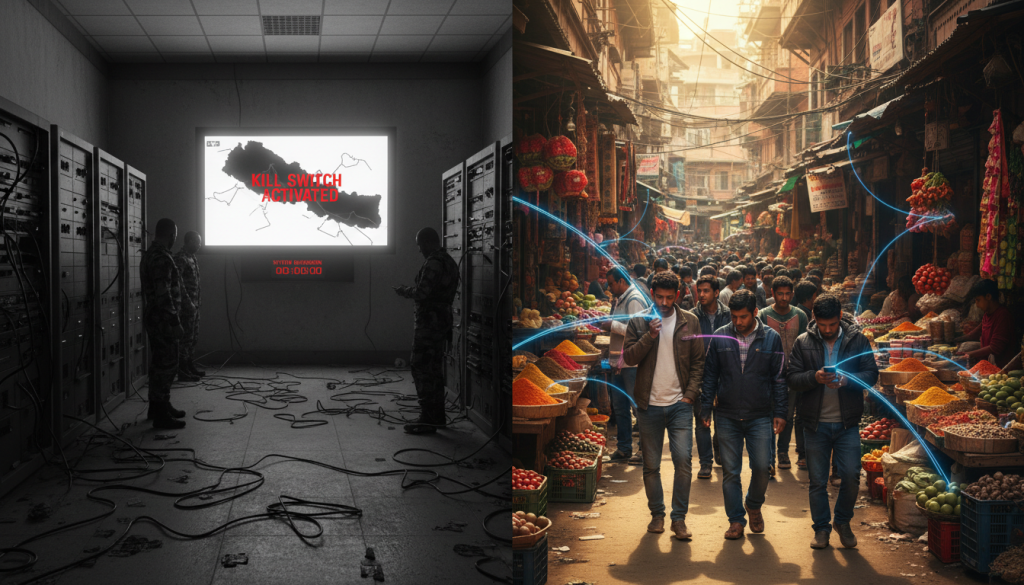
When a government severs connection to the global internet, traditional messaging applications—reliant on centralized servers—immediately cease to function. However, decentralized platforms are engineered to operate “off-grid” by creating local mesh networks. These networks utilize short-range communication protocols like Bluetooth and Wi-Fi Direct to allow devices to connect directly to one another, passing messages like digital runners in a relay race. This creates a resilient communication layer that exists independently of internet service providers.
The Case of Nepal and the Failure of the Kill Switch
Recent events in Nepal serve as a powerful case study for this technology. During periods of political unrest, the government implemented severe internet restrictions. Yet, users turned to applications like BitChat, a platform developed by a team associated with Jack Dorsey’s TBD. BitChat leverages Bluetooth to create ad-hoc networks, allowing users in close physical proximity to exchange messages without any cellular or Wi-Fi data connection. As reported by industry sources, this capability rendered the state’s “kill switch” largely ineffective. Even in geographically isolated areas, the mesh network effect meant that information could still flow, provided a chain of users existed to relay it. This demonstrates a fundamental shift: the state can control the backbone, but it struggles to control the airwaves between individual devices.
Briar and the Synchronization by Contact
Another leading application in this space is Briar. Briar takes a distinct approach to offline communication. While it also supports Wi-Fi and Bluetooth synchronization, it is particularly mature in its “synchronization by contact” feature. This allows two devices to exchange an entire message history simply by being physically close and initiating a sync, without ever needing to connect to the internet. This is highly effective for activists and journalists who meet in person but need to maintain a secure, persistent channel of communication that leaves no digital trail on a central server. Briar’s design philosophy prioritizes security and resilience over user-friendliness, making it a specialized tool for high-risk environments.

Shielding Privacy Against Legislative Intrusion
While the physical front involves blocking access, the legislative front, particularly in Europe, aims to undermine privacy from within. The EU’s “Chat Control” proposal seeks to mandate the scanning of all private messages for illicit content. This requires platforms to have access to message content, which is antithetical to true end-to-end encryption. Decentralized platforms offer a structural solution to this problem by eliminating the central point of control where such scanning could be mandated.
Session and the Onion Routing Model
Session is a prominent example of a platform designed to resist mass surveillance. Unlike Signal or WhatsApp, Session does not require a phone number to create an account, severing the link between a user’s identity and their communications. It uses a decentralized network of “onion” routers, similar to Tor, to route messages. Each message is wrapped in multiple layers of encryption and passed through several volunteer-operated nodes. The node operators only see the previous and next hop, not the final destination or the message content. This makes it computationally infeasible for any single entity, including a government, to monitor all communications on the network. For European citizens facing Chat Control, using Session means there is no central company to serve a warrant to, and the architecture itself prevents the mass scanning of message content.
Jami and the Fully Distributed Model
Jami (formerly GNU Ring) takes decentralization a step further by being fully distributed. It uses a distributed hash table (DHT) for peer discovery, similar to the BitTorrent protocol. There are no central servers whatsoever. Calls, messages, and file transfers occur directly between peers whenever possible. This peer-to-peer architecture is inherently resistant to censorship and surveillance. If a government attempts to block Jami, it would have to block the entire DHT, which is a decentralized and constantly changing network. For citizens and organizations seeking a tool that aligns with ethical compliance and privacy by design, Jami represents a move away from corporate-controlled platforms toward a user-sovereign communication model.
Critical Analysis: The Realities of Decentralized Resistance
While the promise of decentralized technology is compelling, a critical analysis reveals significant challenges and trade-offs. The transition from centralized to decentralized systems is not merely a software update; it is a fundamental shift in user responsibility and infrastructure dependency. This “Zumim Angle” of analysis moves beyond techno-optimism to address the practical hurdles of widespread adoption.
The User Discipline Imperative
Centralized platforms offer convenience at the cost of control. Decentralized platforms reverse this equation. Managing a secure communication channel in a P2P network often requires active user participation. This includes the secure management of private keys, which are the cryptographic proof of identity. Losing a key often means losing access to one’s identity and message history permanently, with no “forgot password” recovery option. Furthermore, maintaining the health of the network—such as updating software on personal devices and potentially running relay nodes—falls on the users themselves. This demands a level of technical literacy and discipline that the average smartphone user is not accustomed to. The security of the network is only as strong as the practices of its individual users.
The Hardware Paradox
A critical, often overlooked, vulnerability lies in the hardware layer. Decentralized P2P apps like BitChat and Briar rely entirely on the smartphone’s radio hardware—specifically, Bluetooth and Wi-Fi chips—to function. These radios are controlled by the device’s operating system and firmware. If hardware manufacturers (such as Apple, Samsung, or Google) face government pressure to restrict or “lock down” these radio interfaces, the efficacy of these apps could be nullified. For example, if an operating system update disables the ability for third-party apps to use Bluetooth in the background or for direct device-to-device discovery, the mesh network capability is broken. The smartphone, therefore, becomes a dual-use tool: it can be an instrument of liberation if its hardware is open, or a cage if its access is restricted. This places the future of decentralized resistance at the mercy of hardware policy and corporate compliance.
Comparative Maturity: Briar vs. BitChat
Not all decentralized platforms are created equal. Briar, for instance, is a mature, open-source project focused heavily on security and resilience, particularly for activists and journalists. Its strength lies in its robust offline synchronization and its focus on the contact-based exchange of information. BitChat, on the other hand, is a newer entrant that is closely tied to the Bitcoin and decentralized finance (DeFi) ecosystem, leveraging the TBD framework. While BitChat’s integration with this broader ecosystem could offer future functionalities, Briar currently stands as the more battle-tested tool for pure, secure communication in high-censorship environments. This distinction is crucial for users choosing a tool based on their specific threat model.
The Strategic Convergence of Technology and Liberty
The events of 2026 highlight a strategic convergence where technology is directly responding to political and legislative pressure. The development of decentralized messaging is no longer a niche pursuit for tech enthusiasts; it has become a necessary infrastructure for digital civil liberties. The “war of networks” is forcing a re-evaluation of how communication systems are built.
From Corporate Platforms to Sovereign Infrastructure
For decades, digital communication has been dominated by centralized platforms that aggregate user data and control the infrastructure. This model is now being challenged by the dual pressures of state censorship and mass surveillance. Decentralized platforms transform the smartphone from a passive terminal accessing a corporate service into an active node in a sovereign network. Each user’s device becomes a piece of the infrastructure itself. This paradigm shift means that communication resilience is distributed across the user base, making it incredibly difficult to dismantle. It represents a move from a client-server model to a peer-to-peer mesh, where authority and control are diffused.
The Role of Ethical Compliance
In the European context, the rise of decentralized platforms is reframing the concept of compliance. For citizens and organizations, using apps like Session or Jami is becoming a form of “ethical compliance”—a proactive step to ensure privacy and security in a landscape where regulatory frameworks may conflict with fundamental rights. These tools are not merely evading regulations; they are building systems that are structurally incapable of complying with mass surveillance mandates, thereby forcing a legal and ethical debate on the limits of state power in the digital age.
Conclusion: The Imperative of Decentralization
The year 2026 has crystallized a critical truth: in an era of increasing digital centralization, decentralization is no longer a luxury or a “cyberpunk” aesthetic. It has become the only technically viable response to the concentration of power in the hands of states and large technology corporations. The dual fronts of physical network blocking and legislative intrusion have exposed the vulnerabilities of our current communication models.
While challenges remain—particularly regarding user discipline and the hardware paradox—the trajectory is clear. Applications like BitChat, Briar, Session, and Jami are pioneering a new frontier of digital resistance. They offer a glimpse into a future where communication is resilient by design, private by architecture, and sovereign by user control. For individuals, communities, and nations seeking to preserve digital freedom, the path forward involves embracing these decentralized technologies. The network war is here, and the tools for resistance are already in our hands, waiting to be activated. The future of communication will not be built in a central server farm, but in the interconnected mesh of millions of individual devices, creating a web that is as resilient as it is free.

Regis Vansnick is a recognized expert with extensive experience at the intersection of technology, business, and innovation. His professional career is marked by a deep understanding of digital transformation and strategic management.


