

In the dead of night, U.S. military forces launched a series of precision strikes against key targets in Venezuela, catching the world by surprise. This operation, aimed at disrupting alleged threats to regional stability, unfolded with swift efficiency, but its roots traced back to an unlikely indicator: a surge in pizza orders near the Pentagon. Fourteen hours before the missiles lit up the sky, a social media post from the account @pizzintwatch flagged an anomalous spike in activity at local pizza chains, hinting at heightened preparations within the U.S. defense establishment.
This wasn’t mere coincidence. The post, shared on X (formerly Twitter) at https://x.com/pizzintwatch/status/2007152263471534345, detailed unusual traffic at Domino’s Pizza, located just 1.4 miles from the Pentagon, and Papa Johns, 2.3 miles away. What seemed like a quirky observation quickly gained traction as events unfolded, raising questions about the intersection of everyday consumer data and national security.
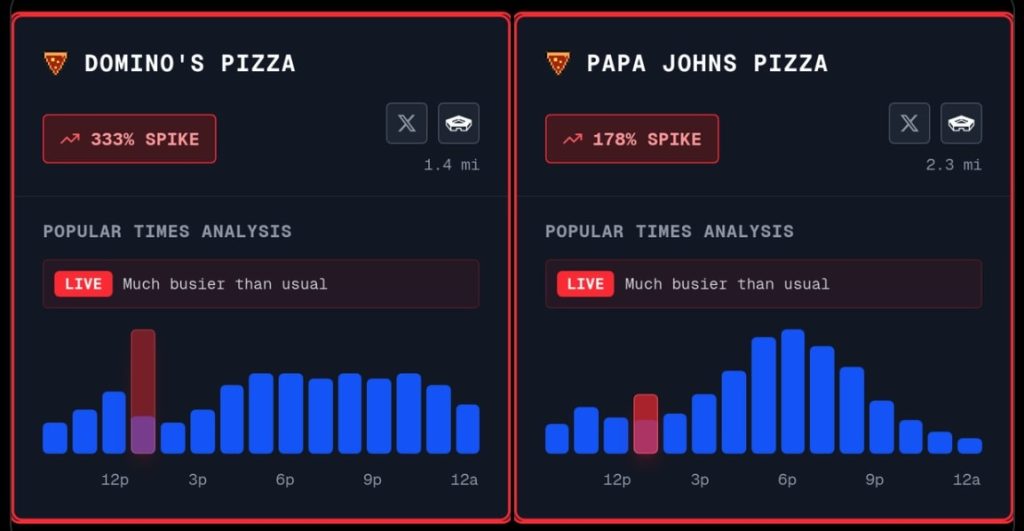
Domino's Pizza (1.4 miles from the Pentagon) is experiencing an extreme spike in activity at 333%. Papa Johns Pizza (2.3 miles from Pentagon) also reports high activity at 178%. DEFCON level is 4. pic.twitter.com/v8NBi1hipv
— Pentagon Pizza Watch (@pizzintwatch) January 2, 2026
Decoding the pizza surge: From normal traffic to red alerts
At the heart of this story is the concept of open-source intelligence (OSINT), where publicly available data reveals hidden patterns. The @pizzintwatch account specializes in monitoring pizza delivery trends near military hubs as a proxy for operational tempo. On that fateful day, the data showed Domino’s experiencing a 333% increase in activity compared to typical levels, while Papa Johns saw a 178% uptick.
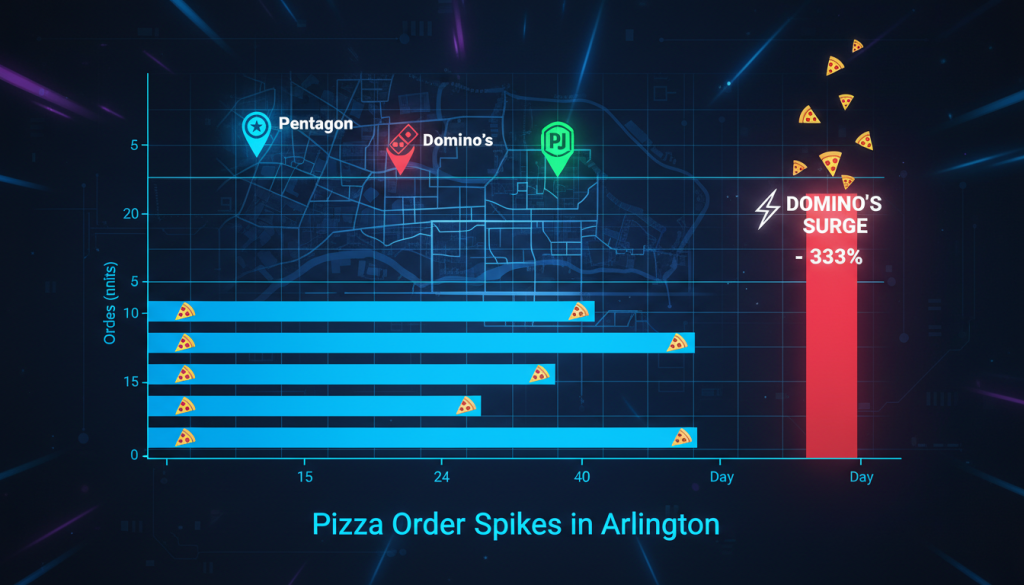
Under normal circumstances, these pizza outlets handle a steady flow of orders from office workers, families, and nearby residents. However, spikes like this often correlate with late-night mobilizations, where personnel are called in for briefings, planning sessions, or rapid deployments. The visual representation in the post—blue bars for average traffic and a stark red or pink bar for the anomaly—highlighted the deviation clearly, transforming mundane delivery stats into a potential harbinger of action.
Why pizza? The logic behind the indicator
Pizza is a go-to choice for fueling extended work sessions in high-stress environments like the Pentagon. When hundreds or thousands of staff are suddenly on-site outside regular hours, demand for quick, shareable food skyrockets. This isn’t random; historical patterns have shown similar surges preceding major operations, from troop movements to airstrikes.
Comparing the spikes: Data breakdown
To understand the significance, consider the percentages: a 333% spike means activity more than tripled the norm, far exceeding fluctuations from events like sports games or holidays. Papa Johns’ 178% increase, while lower, reinforced the trend, suggesting a broad mobilization rather than an isolated incident.
The DEFCON connection: Elevating the stakes
What added drama to the @pizzintwatch post was its explicit link to DEFCON levels, the U.S. military’s defense readiness condition system. The account noted a DEFCON level of 4, indicating increased intelligence watch and strengthened security measures, but not yet at the highest alert (DEFCON 1). This integration of pizza data with alert status painted a picture of impending action, as if the food orders were a real-time barometer of tension.
DEFCON 4 typically involves routine vigilance, but when paired with tangible indicators like this, it amplifies the sense of urgency. Observers on social media speculated that the Venezuela operation—targeting infrastructure linked to alleged illicit activities—aligned perfectly with such preparations. The post’s timing, just hours before confirmation of the strikes, underscored how OSINT can democratize access to what was once classified insight.
Historical precedents for alert-linked predictions
This isn’t the first time food trends have tipped off global events. Similar monitoring has flagged anomalies before operations in the Middle East or during heightened U.S.-Russia tensions. By tying pizza metrics to DEFCON, @pizzintwatch provides a narrative layer, making abstract military jargon relatable and immediate.
Technical insights: How Google Popular Times became a security vulnerability
The backbone of this OSINT method lies in Google’s Popular Times feature, which aggregates anonymized GPS data from smartphones to estimate crowd levels at businesses. Users with location services enabled contribute to this dataset unknowingly, creating a live heatmap of activity. For pizza places near sensitive sites like the Pentagon, this data can inadvertently reveal surges in human presence.
Google anonymizes the information to protect privacy, stripping personal identifiers and using aggregated trends. However, the sheer volume of data points allows for pattern recognition. A sudden influx of devices at a location signals more than just hungry customers—it points to coordinated gatherings. This has turned a consumer tool into a potential security gap, as adversaries or watchful civilians can infer military movements without hacking restricted systems.
From data collection to real-world implications
The process begins with users’ location history, processed through algorithms to generate hourly busyness graphs. When applied to areas like Arlington, Virginia, near the Pentagon, anomalies stand out. Experts note that while Google has safeguards, the openness of this data exposes institutions to passive surveillance, prompting calls for better mitigation strategies.
| Pizza Chain | Distance from Pentagon | Activity Spike (%) | Implied Significance |
|---|---|---|---|
| Domino’s Pizza | 1.4 miles | 333% | Extreme mobilization indicator |
| Papa Johns Pizza | 2.3 miles | 178% | Supporting evidence of high activity |
| Average Local Outlet | N/A | 0-50% | Normal fluctuations |
| Historical Peak (e.g., Past Events) | Varies | 100-200% | Moderate alert signal |
The broader implications for modern surveillance and military secrecy
As this incident illustrates, the era of airtight military secrets may be waning. If a single X account can predict a geopolitical event through something as innocuous as pizza orders, it challenges traditional notions of operational security. Governments must now contend with a world where big data, social media, and OSINT empower anyone with an internet connection to piece together sensitive puzzles.
In conclusion, the 333% spike at Pentagon (area Domino’s wasn’t just about late-night snacks) it was a window into the machinery of modern warfare. This Venezuela operation serves as a case study in how everyday digital footprints can erode secrecy. Readers interested in global affairs should stay vigilant, exploring OSINT tools themselves to better understand the hidden signals shaping our world. By recognizing these patterns, we gain insight into the unseen forces at play, fostering a more informed public discourse.

Loïc Vansnick is the leader of the Zumim project, whose expertise is based on a rare combination of two fundamental areas: he is a certified civil engineer and management engineer


