
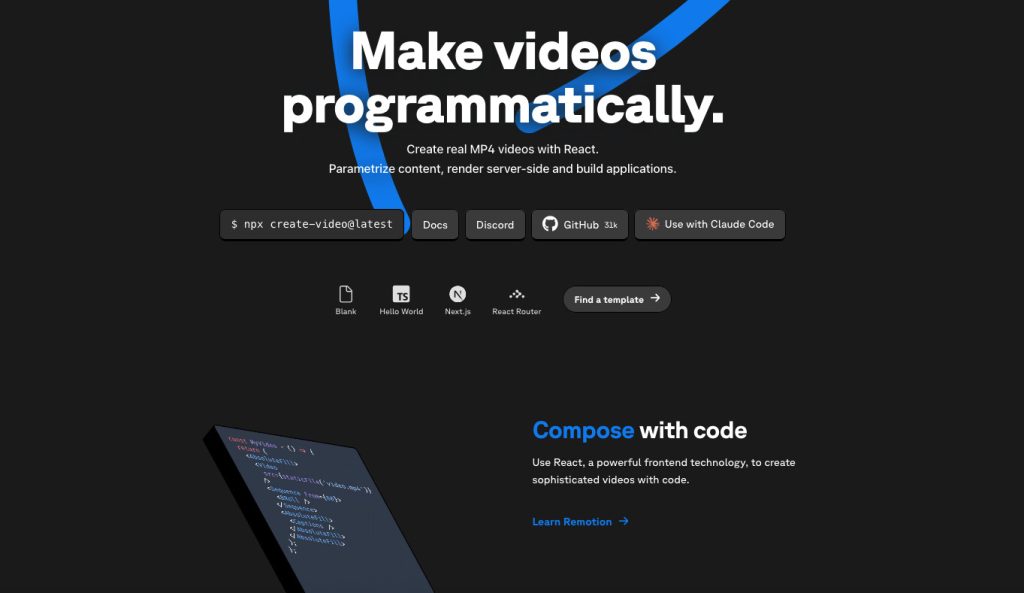
Imagine a world where videos are not crafted by hand in editing suites but generated seamlessly through lines of code, adapting in real-time to data inputs without a single human intervention. This is the promise of Remotion AI automation, a paradigm shift blending programmatic precision with artificial intelligence. As businesses seek efficiency in content creation, tools like Remotion and Claude are redefining video engineering, turning complex visuals into automated, scalable assets.
The Logic vs. Pixels Argument: Deterministic code over probabilistic AI
In the evolving landscape of video creation, a fundamental debate arises between traditional generative AI tools and code-based frameworks like Remotion. Generative models, such as those from Sora or Runway, operate on probabilistic principles. They analyze vast datasets to predict and generate visuals, often producing stunning results but with an inherent risk of inconsistencies or “hallucinations”—unexpected artifacts that deviate from the intended output. This unpredictability stems from their reliance on machine learning algorithms that approximate creativity rather than enforce it.
Contrast this with Remotion, a deterministic approach where videos are built using React components rendered into formats like MP4. Here, every pixel is dictated by code, ensuring exact outcomes. For sovereign companies—those prioritizing control and independence—this method reigns supreme. Code is editable, allowing developers to tweak elements precisely without retraining models. It supports version control through systems like Git, enabling collaborative iterations and rollbacks that probabilistic AI lacks.
Why determinism matters for scalability
Scalability is a key advantage. Generative AI might excel in one-off creative bursts, but it struggles with mass production where consistency is paramount. Remotion’s code-driven nature allows for templates that can be reused and modified at scale, reducing costs and time. Businesses can automate video generation for thousands of variations, such as personalized marketing clips, without the variability that plagues AI-generated content.
Editable and hallucination-free outputs
Moreover, the editability of code fosters creative sovereignty. Users aren’t at the mercy of black-box algorithms; they can inspect, debug, and enhance the underlying logic. This transparency eliminates hallucinations, ensuring outputs align perfectly with specifications. In sectors like e-commerce or education, where accuracy is critical, this deterministic edge positions Remotion as a superior choice over pixel-pushing generative tools.

The technical workflow: Integrating Claude code with Remotion
At the heart of Remotion AI automation lies a seamless technical workflow that leverages Claude as a coding agent to orchestrate video production. Claude, an advanced AI model, acts as a terminal agent, generating React components that Remotion then compiles into high-quality video files. This integration shifts video creation from graphical user interfaces (GUIs) in tools like Adobe Premiere to integrated development environments (IDEs), embodying the “shift-left” principle in video engineering.
The process begins with Claude analyzing requirements, perhaps from a user prompt or data feed. It writes modular React code, defining animations, transitions, and overlays. Remotion’s renderer takes this code and produces the final MP4, handling aspects like frame rates and resolutions programmatically. This automation eliminates manual editing, allowing for real-time adjustments based on variables.
From code to render: Step-by-Step breakdown
Consider a typical sequence: First, input data—such as JSON objects containing text, images, or metrics—is fed into Claude. The AI generates a React composition, incorporating libraries for effects. Remotion’s CLI tools then render the composition server-side, often on cloud infrastructure for efficiency. The output is a polished video ready for distribution.
The Shift-Left phenomenon in video
This “shift-left” moves creative decisions earlier in the development cycle, from post-production to the coding phase. Developers, rather than designers, become the architects of visual narratives. It democratizes video production, making it accessible to those with programming skills, and integrates seamlessly with existing software ecosystems.
Use cases for the sovereign entrepreneur: Practical applications
For sovereign entrepreneurs—those building self-reliant businesses—Remotion AI automation opens doors to innovative use cases that enhance efficiency and personalization. One prominent application is data-driven video generation, where videos are created automatically from databases. For instance, a JSON file with sales data can trigger customized reports, visualized with charts and narrations, all rendered via Remotion.
Another workflow involves processing raw footage: Claude analyzes the video, employs tools like Whisper for transcription, and instructs Remotion to add dynamic overlays, such as branded text or animations. The entire process—from analysis to upload—requires zero human touchpoints, ideal for content-heavy operations like social media management.
Personalized advertising and reporting
In advertising, entrepreneurs can generate tailored video ads. By inputting customer data, Claude crafts React components that Remotion renders into personalized clips, boosting engagement rates. For reporting, automated videos summarize metrics, making complex data digestible for stakeholders.
Automated content pipelines
Content creators benefit from pipelines where AI agents handle editing. Raw uploads are transcribed, enhanced with effects, and distributed across platforms, streamlining workflows for YouTubers or marketers.
The sovereignty and Zero-Human company angle
Remotion AI automation aligns perfectly with the zero-human company (ZHC) concept, where operations run autonomously. By combining Claude’s coding prowess with Remotion’s rendering, brands can maintain a constant video presence on platforms like X or YouTube using minimal resources—a $5/month Linux server and an API key suffice.
This setup spells the decline of traditional creative agencies, which rely on human labor for editing and production. Sovereign entrepreneurs gain independence, scaling video output without proportional costs. Automation ensures 24/7 operation, from generating daily updates to responding to real-time events, fostering a resilient business model.
Empowering brand autonomy
Brands achieve creative sovereignty, controlling every aspect through code rather than outsourcing. This reduces dependencies and enhances agility in fast-paced digital landscapes.
Disrupting agency models
The shift disrupts agencies by commoditizing video production. What once required teams can now be handled by AI agents, lowering barriers for startups and enabling hyper-personalized content at scale.

Critical caveat: The role of digital literacy in automation
While Remotion AI automation promises efficiency, it’s not a plug-and-play solution. The rendering is automated, but defining the “creative logic” demands a solid code architecture. Users must possess digital literacy to structure components effectively, going beyond simple prompts.
This requirement underscores that true automation stems from thoughtful design. Without it, outputs may lack polish, emphasizing the need for skills in React and programmatic thinking.
Conclusion: Embracing the future of automated video
Remotion AI automation, powered by Claude, transforms video engineering from an art to a science, offering deterministic control, scalable workflows, and sovereignty for entrepreneurs. By integrating code with AI, it paves the way for zero-human operations, challenging traditional models. To harness this potential, invest in digital skills and explore these tools—start experimenting today to automate your video needs and stay ahead in the content revolution.

Tanguy is a key figure in the team, responsible for in-depth analysis of technological trends and their practical application in modern business. One of his specialities are the blockchains.


